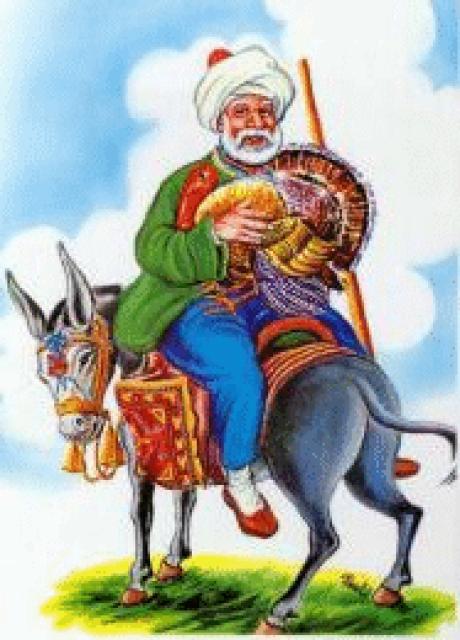
Nasreddin
 Turkey
Biography of Hodja Nasreddin
The Folklore Character of the Muslim EastIt is believed that the first stories about Hodja Nasreddin appeared in the 13th century, and it is possible that during those times there really lived a witty and resourceful jester named Nasreddin, whose memory has passed through the centuries, becoming a significant part of Eastern culture. Hodja Nasreddin is a folklore character from the Muslim Middle East and Central Asia. He is the main protagonist of numerous short stories, anecdotes, fables, and folk tales that are widely spread in these regions. Hodja Nasreddin combines the traits of a philosopher, sage, simpleton, and clever talker, and the stories about him, numbering over a thousand, usually exhibit subtle humor and have a moral embedded within.
The Origins of Hodja Nasreddin
It is commonly believed that the first stories about Hodja Nasreddin appeared in the 13th century, and it is possible that during those times there really lived a witty and resourceful jester named Nasreddin, whose memory has passed through the centuries, becoming a significant part of Eastern culture. Many nations claim that Hodja Nasreddin lived in their regions. For example, Turkish sources assert that in the 13th century, a certain Nasreddin, who was born in 1208 and lived a long life, died in 1284 at a venerable age, actually lived in what is now modern-day Turkey. It is said that he was born in the village of Hortu, located near the city of Sivrihisar in the Eskişehir Province. Nasreddin then studied in Konya, the capital of the Seljuk Sultanate of Rum, and lived and worked in Akşehir, where he eventually passed away. His tomb is still shown in Akşehir, and an annual International Nasreddin Hodja Festival is held there from the 5th to the 10th of July. A Turkish historian named Mikail Bayram conducted extensive research, the results of which showed that the full name of the real prototype of Nasreddin was Nasir ud-din Mahmud al-Khoyi. He was born in the city of Khoy in the West Azerbaijan Province of Iran, received his education in Khorasan, and became a disciple of the famous Islamic scholar Fakhr al-Din al-Razi. The Baghdad caliph sent him to Anatolia to organize resistance against the Mongol invasion. He served as a qadi, an Islamic judge, in Kayseri and then became a vizier at the court of Sultan Kaykaus II in Konya. He had visited numerous cities, acquainted himself with various cultures, and was renowned for his wit. Thus, it is quite possible that he was the first hero of amusing or instructive stories about Hodja Nasreddin. However, it seems doubtful that such an educated and influential person would ride a humble donkey and quarrel with his cantankerous and unattractive wife. But what a nobleman cannot afford, a hero of funny and instructive anecdotes can, can't he?
On the other hand, there are other studies that suggest that the image of Hodja Nasreddin is about five centuries older than what is generally believed in modern science. Generations passed down tales and anecdotes through oral tradition across the tea houses and caravanserais of Asia, and the inexhaustible folk imagination added new fables and jokes to the collection of stories about Hodja Nasreddin, spreading them across a vast territory. The themes of these stories became part of the folklore heritage of several nations, and the differences between them can be explained by the diversity of national cultures. Most of these stories depict Nasreddin as a poor villager and have no specific references to the time of the narrative – their protagonist could have lived and acted in any era and time period.
The Literary Legacy of Hodja Nasreddin
The stories about Hodja Nasreddin were first literary processed in 1480 in Turkey, being recorded in a book called "Saltukname," and the oldest manuscript with stories about Nasreddin dates back to 1571. In the 20th century, these stories were brought to the big screen and theatrical stage. Today, the stories about Hodja Nasreddin have been translated into many languages and have long become part of the world literary heritage. For example, 1996-1997 was declared the International Year of Hodja Nasreddin by UNESCO. Russian readers are familiar with stories about Hodja Nasreddin not only through collections of fables and anecdotes but also through the excellent novels by Leonid Solovyov, such as "Disturber of the Peace, or Hodja Nasreddin in Bokhara" and "The Enchanted Prince," which are united in "The Tale of Hodja Nasreddin" and have been translated into dozens of foreign languages.
The name Nasreddin is written differently in many languages, but they all trace back to the Arabic Muslim personal name Na'ar ad-Din, which translates to "Victory of Faith." In the various stories of different nations, Nasreddin is addressed differently – it could be a respectful address of "hodja," "molla," or even the Turkish "efendi." And finally, one of the most famous stories about Hodja Nasreddin:
Once, at the bazaar, Hodja witnessed a fat tea house owner shaking down a poor beggar, demanding payment for his meal. "But I only smelled your pilaf!" the beggar justified himself.
"But the smell is also worth money!" replied the fat man.
"Wait, let him go – I will pay you for everything," said Hodja Nasreddin as he approached the tea house owner. The man released the poor beggar. Hodja took out a few coins from his pocket and shook them near the tea house owner's ear.
"What is this?" the man exclaimed.
"Whoever sells the smell of a meal receives the jingle of coins," Hodja calmly replied.


