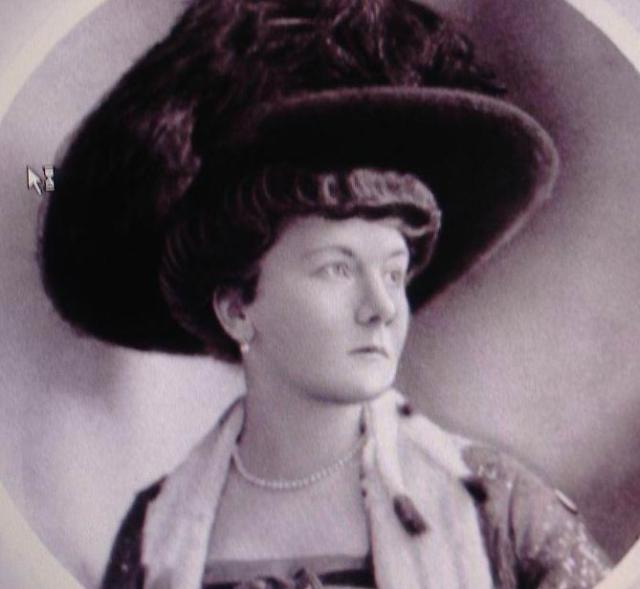
Natalia Aktseri
 Latvia
Biography of Natalya Akhtseri
Natalya Konstantinovna Iretskaya-Akhtseri was an opera and chamber singer (lyrico-coloratura soprano), as well as a vocal teacher. She was the niece of N. Iretskaya. She studied vocal technique under her aunt at the St. Petersburg Conservatory, graduating in 1900. In 1903, she made her debut as Juliet in "Romeo and Juliet" at the Bolshoi Theatre in Moscow. From 1904, she joined the St. Petersburg "New Opera" (the theatre of the St. Petersburg Conservatory). Her roles included Ludmila in "Ruslan and Ludmila," Marfa in "The Tsar's Bride," Snegurochka in "Snegurochka," Rosina in "The Barber of Seville" by G. Rossini, Gilda in "Rigoletto," Lakmé, Despina in "Cosi fan tutte," Cerlina in "Fra Diavolo, or The Inn in Terracina," Philine, Marguerite de Valois, Musetta in "La Bohème," Manon, and Micaela. She also performed chamber concerts featuring works by J.S. Bach, F. Liszt, M. Moszkowski, and J. Brahms.
She partnered with renowned singers of her time, such as O. Kamionsky, N. Figner, M. Dolina, K. Dorliak, N. Kedrov, and M. Chuprynnyk. From 1910 to 1923, she taught at the Conservatory of St. Petersburg-Petrograd and held the position of professor from 1917. Her notable students included K. Aleneva, M. Elizarova, V. Emelyanova, N. Zaitseva, and others.
The Career as a Vocal Education Program Developer
Natalya Konstantinovna Iretskaya-Akhtseri was the author and developer of a vocal education program. In May 1928, the newspaper "Tonight" published a short note: "Three years ago, Natalya Konstantinovna Iretskaya-Akhtseri, a professor at the St. Petersburg Conservatory, arrived in Riga from Paris. She was one of the most significant authorities in Russia in the field of vocal arts. Shortly before Natalya Konstantinovna's departure from the USSR, she was entrusted with the task of developing vocal education programs for Russian conservatories. She completed this task so successfully that the Conservatory Council deemed it necessary to thank Natalya Konstantinovna with a special letter from all its members, led by A.K. Glazunov. In this letter... the programs were described as exceptionally well-composed and were referred to as an "encyclopedia of musical-vocal literature." "I worked on developing these programs from May to September 1923," recalls Prof. N.K. Iretskaya-Akhtseri. "After completing this work, I went abroad for an 8-month vacation, which I later extended. I still haven't been able to return because doctors consider the climate in St. Petersburg harmful to me and do not allow me to go there. In Paris, where I settled, my former student, Mrs. A. Valman, approached me and offered me to come to Riga as a singing teacher in her school. The prospect of lively and active work tempted me. Besides, the prospects for the opening and existence of a Russian conservatory in Paris did not seem bright... Mrs. Valman's school did not satisfy me in terms of organization. I left it. Gradually, I gathered a group of very serious and dedicated students who worked so passionately that I decided to hold the next exam in public..." (quoted from: Natalya Konstantinovna Iretskaya-Akhtseri. Author C. Zhuravlev).
Grave
The singer's grave is located at the Pokrov Cemetery in Riga (in sector Z, No. 3).


