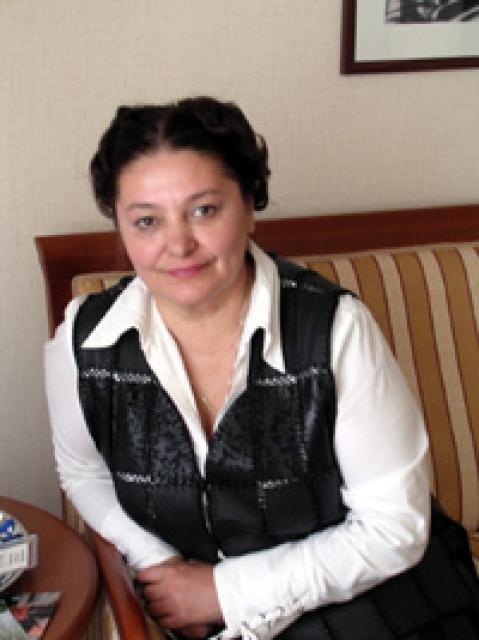
Natalia Bondarchuk
 Russia
Biography of Natalya Bondarchuk
Natalya Bondarchuk is a Russian actress and director. She was born on May 10, 1950, in Moscow, to director Sergey Bondarchuk and actress Inna Makarova. Bondarchuk graduated from the acting department of the All-Russian State Institute of Cinematography (VGIK) in 1971, studying under the guidance of Sergey Gerasimov and Tamara Makarova. She later completed her studies at the directing department of VGIK in 1975.

Bondarchuk made her film debut in 1970, in the movie "By the Lake," and went on to appear in films such as "The Soldier Came from the Front" and "You and Me." However, her breakthrough role came in 1972 when she portrayed Hari in Andrei Tarkovsky's philosophical science fiction film "Solaris." Following the success of "Solaris," Bondarchuk received up to 40 offers to act per month. However, she chose to be selective in her roles to avoid devaluing her image. Over the years, she played only about ten roles, but each one of them was significant.
As an actress, Bondarchuk portrayed Maria Volkonskaya in Vladimir Motyl's drama "The Star of Captivating Happiness," Madame de Renal in the television adaptation of "The Red and the Black," and Princess Sofia in the historical duology "Youth of Peter" and "At the Beginning of Glorious Days," directed by Sergey Gerasimov. She received numerous letters questioning her decision to take on the role of Sofia, a character seen as bloodthirsty. However, Bondarchuk saw Sofia differently, considering her as a precursor to Catherine the Great, the first emancipated woman.
In 1975, Bondarchuk made her debut as a director and screenwriter with the novella "Unfortunate Matryona" in the anthology "Poshekhonskaya Starina" based on Saltykov-Shchedrin's novel. She continued her directing career with films such as "The Bronze Horseman," adapted from Alexander Pushkin's poem, and "The Living Rainbow," based on Nikolay Nosov's novel. However, her most famous works as a director are the duology "Bambi's Childhood" and "Bambi's Youth," written in collaboration with writer Yuri Nagibin. These films, released in the late 1980s, featured Bondarchuk's closest relatives, including her son Ivan Burlyaev, her mother Irina Makarova, her husband Nikolay Burlyaev, and herself. The duology received over fifteen awards and was watched by nine million children within the first few months.
Bondarchuk also ventured into documentary filmmaking, focusing on the family of Nikolay Konstantinovich Roerich, an artist and philosopher whose worldview she embraced in her thirties. She embarked on the Trans-Himalayan Expedition, which inspired her television documentaries about the Roerichs and the Himalayas.
In 1999, Bondarchuk completed the film "The Love of My Soul," which tells the story of Alexander Pushkin and Maria Volkonskaya. During the scriptwriting process, she extensively researched more than two thousand books to capture the essence of Pushkin's character. She aimed to create a romanticized image of Pushkin, portraying him as a young, passionate, and bright figure. The film is based on the memories of Maria Volkonskaya, who held a special place for Pushkin in her heart.
Despite being born in Moscow, Bondarchuk prefers living in the countryside rather than the city. She dislikes driving but has traveled to 42 countries, including Norway and New Zealand, by car. Although not fond of technology, she spent hours in her editing room, utilizing advanced techniques during the production of "The Love of My Soul."
Natalya Bondarchuk is married to actor and director Nikolay Burlyaev. They have a son named Ivan, who is a student at the Moscow State Conservatory. Bondarchuk's career has spanned acting, directing, and documentary filmmaking, leaving a lasting impact on the Russian film industry.


