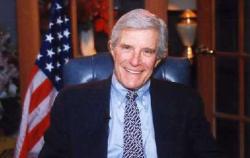
Nelson Rockefeller
 USA
USA- Biography of Nelson Rockefeller
- Early Career and Rockefeller Center
- Political Career
- Vice Presidency
- Later Years and Legacy
Biography of Nelson Rockefeller
Nelson Rockefeller, the 41st Vice President of the United States, was a member of America's wealthiest family, whose name became synonymous with wealth and power. He was the grandson of John Davison Rockefeller, an oil magnate.
Early Career and Rockefeller Center
In the early 1930s, Rockefeller worked in banks in New York, Paris, and London. It was during this time that he dedicated himself to creating the "Rockefeller Center" in New York City, at the request of his father and due to his own interest in architecture. In 1933, he commissioned Mexican artist Diego Rivera, known for his left-wing views, to paint murals for the Rockefeller Center. However, after the completion of the murals, Rockefeller asked Rivera to remove the image of Soviet leader V.I. Lenin, as it caused controversy in the United States. When Rivera refused, a scandal erupted between him and Rockefeller. Rockefeller paid Rivera for his work and completely destroyed the murals. The phrase "This is my wall!" became a popular saying in the United States. The incident received widespread attention in the media and sparked intense debates. This story was also depicted in films, including the 2002 film "Frida."
Political Career
In politics, Rockefeller was a member of the Republican Party starting from the 1940s. Under Democrats Franklin D. Roosevelt and Harry S. Truman, he participated in various government commissions. From 1951 to 1952, he served as the Chairman of the Advisory Council on International Development. In the Republican administration of Dwight D. Eisenhower, he was the Deputy Secretary of State. From 1959 to 1973, he served as the Governor of New York State and gained a reputation as a liberal and a leader of the moderate wing of the Republican Party. Starting from 1960, he attempted to secure the Republican Party's nomination for presidency but was unsuccessful four times in a row (1960, 1964, 1968, 1972).
Vice Presidency
After Richard Nixon's resignation in 1974, Nelson Rockefeller became the Vice President under Gerald Ford, who himself became President after Spiro Agnew, the originally elected Vice President, resigned before Nixon. According to the 25th Amendment to the United States Constitution, the vacancy in the Vice Presidency must be filled by Congress upon the President's recommendation. Ford chose Rockefeller, who had been an effective governor of the largest state for a long time. The members of both houses of Congress were more concerned about the candidate's affiliation with the financial elite and immense personal wealth rather than his political abilities, which were undeniable. After lengthy debates, the House of Representatives and the Senate approved Rockefeller as Vice President on December 19, 1974. He became the second and so far the last Vice President to assume office under the 25th Amendment, following Ford himself. Rockefeller lavishly decorated and furnished the Vice Presidential residence in Washington, D.C. at his own expense, although he did not actually live there, as he already had a house in Washington. Upon leaving the position, he left the entire set-up in the residence as government property, which has since been used by all subsequent Vice Presidents. During one of his public speeches in 1976, he showed his middle finger to a group of hippies who were mocking him, an act that gained significant attention when it was captured in a widely circulated photograph.
Later Years and Legacy
On November 3, 1975, Rockefeller informed Ford that he considered his Vice Presidency temporary and did not intend to run alongside him in the 1976 election. For the election, Ford's running mate was the prominent Republican Bob Dole, who later unsuccessfully ran for presidency in 1996. However, the Ford-Dole ticket lost to the Democratic ticket of Carter-Mondale. Rockefeller was a longstanding member of the Bilderberg Group.
Nelson Rockefeller passed away in New York City two years after leaving office, on January 26, 1979, from a heart attack during sexual intercourse, as officially stated on his death certificate. Little is known about his mistress, Megan Marshak. His son, Michael Rockefeller, was an ethnographer and anthropologist who tragically died in 1961 during a scientific expedition in New Guinea.