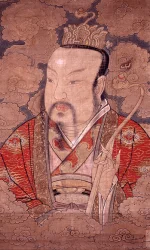
Nichiren
Nichiren was a Japanese Buddhist monk whose forceful teaching of the Lotus Sutra gave rise to a religious tradition that would spread far beyond his own lifetime. Living through famine, epidemics, political upheaval, and the threat of Mongol invasion, he argued that the country’s spiritual and public well-being depended on returning to what he regarded as the Buddha’s highest teaching. His uncompromising criticism of rival schools made him influential, controversial, and repeatedly subject to government punishment.
Early Life and Religious Study
Nichiren was born on 16 February 1222 in the coastal province of Awa, in what is now Chiba Prefecture. His early name was Zennichimaro. He entered Buddhist life as a boy and studied at temples, eventually traveling to leading centers of learning, including Mount Hiei, the headquarters of the Tendai school. He examined a wide range of Buddhist texts and traditions before concluding that the Lotus Sutra expressed the central message of Shakyamuni Buddha and offered the most direct path for people of his age.
In 1253, he began publicly teaching the practice later known as chanting Nam-myoho-renge-kyo, the title of the Lotus Sutra. He took the name Nichiren, often understood as “Sun Lotus.” His approach was direct: he urged people to place the Lotus Sutra at the center of religious life and challenged practices he believed had obscured its significance.
A Controversial Teacher
Nichiren’s 1260 treatise, Rissho Ankoku Ron, addressed the political authorities and argued that the nation’s disasters were linked to its support for teachings he considered mistaken. The work called for a public religious debate and warned that further calamities, including internal revolt and foreign invasion, could follow if the government ignored the matter. It angered adherents of other Buddhist schools and contributed to repeated confrontations with authorities.
He endured more than one period of exile. In 1261 he was banished to the Izu Peninsula, returning in 1263. In 1271, after another clash with officials, he was nearly executed at Tatsunokuchi. The execution was halted, and he was instead sent to Sado Island, where he remained until 1274. The years of exile were especially important to his mature teaching and writing. Government documents from the Mongol Empire had arrived in Japan, and Nichiren’s earlier warnings of invasion appeared increasingly urgent to his followers.
Final Years and Legacy
After his pardon, Nichiren spent several years at Mount Minobu, where he wrote extensively and trained disciples to carry his teachings forward. The Mongol invasions of Japan in 1274 and 1281 intensified the significance attached to his warnings, although the invasions’ failure resulted from multiple military and environmental factors. He continued to teach the Lotus Sutra as the foundation for religious practice and challenged the authorities to reconsider their support for other schools.
Nichiren died on 13 October 1282 at Ikegami, near present-day Tokyo. His followers preserved his writings and developed a range of schools that interpret his legacy in different ways. Across those traditions, his emphasis on the Lotus Sutra, the chanting of its title, and the possibility of religious practice in ordinary life remains central. His life combined deep scriptural study with a willingness to confront political and religious power, leaving a movement whose influence endured for centuries.