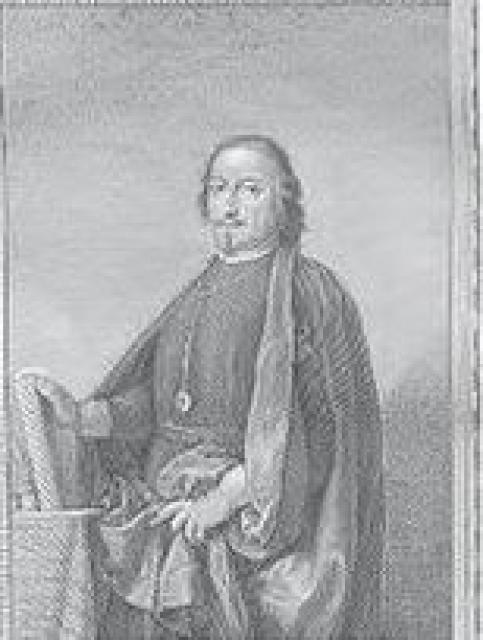
Nicolas Antonio
 Spain
Spain- Nicolás Antonio: The Eminent Spanish Bibliographer
- Literary Pursuits
- Magnum Opus: "Bibliotheca Hispana"
- Scholarly Acclaim
- Additional Contributions
- Legacy and Influence
Nicolás Antonio: The Eminent Spanish Bibliographer
Early Life and EducationNicolás Antonio, born in Seville, Spain, in 1617, embarked on his academic journey at the prestigious University of Salamanca, where he studied from 1636 to 1639.
Literary Pursuits
After returning to his hometown, Antonio dedicated himself to writing and scholarship. He penned several significant works, including "De Exilio," a treatise published in 1659. In 1654, he was dispatched as a representative to Rome, where he resided for several years.
Magnum Opus: "Bibliotheca Hispana"
Antonio's magnum opus, "Bibliotheca Hispana," stands as a testament to his meticulous research and dedication. Published in two parts, "Bibliotheca Hispana nova" (1672) covered Spanish writers from 1500 onwards, while "Bibliotheca Hispana vetus" (1696, published posthumously) explored Spanish literature from ancient times to 1500.
Scholarly Acclaim
Antonio's "Bibliotheca Hispana" gained widespread recognition and became an essential reference work for scholars and historians. Its subsequent editions, including the one edited by Francisco Pérez Bayer in 1787-1788, further enhanced its value.
Additional Contributions
Beyond his seminal bibliography, Antonio authored other notable works, such as "Censura de historias fabulosas" (published posthumously in 1742) and the unpublished "Bibliotheca Hispana rabinica," which remains preserved at the National Library in Madrid.
Legacy and Influence
Nicolás Antonio's meticulous scholarship and groundbreaking contributions to bibliography have left an enduring legacy. His "Bibliotheca Hispana" continues to serve as a cornerstone of Spanish literary and historical research, inspiring generations of scholars.


