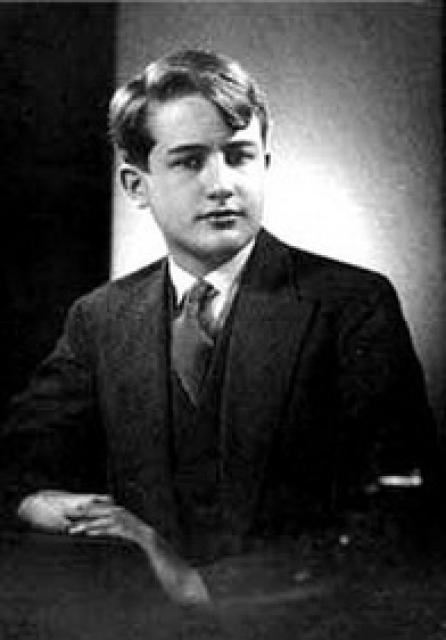
Nicolas Gomez Davila
 Colombia
- A Distinguished Colombian Writer and Thinker
- Return to Bogotá and Marriage
- Business Involvement and Leisure Pursuits
- Influence in Colombian Society
- Intellectual Pursuits
- Literary Contributions
- Reluctant Author
- Publication of "Escolios"
- Posthumous Fame
- Self-imposed Obscurity
- Legacy
A Distinguished Colombian Writer and Thinker
Early Life and EducationNicolás Gómez Dávila (18 May 1913 - 17 May 1994) was born into an affluent bourgeois family in Cajicá, Colombia. At the age of six, he relocated to Europe with his family, where he spent the next 17 years. Gómez Dávila received his education at a Benedictine-run school in Paris. During his vacations, he frequently visited England. However, a severe illness confined him to bed for two years, during which time he privately studied Latin and Greek, instilling a lifelong love of classical literature.
Return to Bogotá and Marriage
At the age of 23, Gómez Dávila returned to Bogotá and promptly married Emilia Nieto Ramos. Despite her previous marriage, she divorced and remarried Gómez Dávila, forming a solid union that lasted for 50 years. They established their home in Bogotá, where they raised their two sons and a daughter.
Business Involvement and Leisure Pursuits
After his marriage, Gómez Dávila, also known as "Don Colacho," immersed himself in self-education and leisurely activities. His family's carpet factory was under the management of his father, so his business involvement was limited to a brief period between his father's death and the transition to his son's leadership. Even as the company's head, Gómez Dávila spent only a few minutes per week at the office, instructing his manager to increase profits. Subsequently, he would lunch with friends at the Bogotá Jockey Club, where he enjoyed playing polo and held an official position. His riding career, however, ended after a fall while attempting to light a cigar on horseback.
Influence in Colombian Society
Gómez Dávila was a prominent figure in Colombian elite society. In 1948, he co-founded the Andean University with Mario Pinzón. Colombian politicians sought his counsel, but despite his cordial relations with the government, he steadfastly avoided political involvement. In 1958, following the fall of a military regime, he declined President Lleras Alberto's offer to be his presidential advisor. Similarly, he turned down an ambassadorship in 1974. While his refusal to hold official positions initially raised eyebrows, it became evident that Gómez Dávila was simply unsuited for public service.
Intellectual Pursuits
Instead, Gómez Dávila dedicated much of his life, particularly after an injury, to his home library. A voracious reader, he would often linger in his library until the early hours of the morning. Over time, he amassed a collection of approximately 30,000 volumes, which became somewhat of a family inconvenience due to its sheer size.
Literary Contributions
A significant portion of Gómez Dávila's library comprised works in foreign languages. In addition to Spanish, Latin, and Greek, he was proficient in French and English, fluent in German and Portuguese, and had dabbled in Danish (to read Kierkegaard in the original) and Russian (which he lamented not mastering due to starting too late). Besides reading, Gómez Dávila regularly hosted gatherings of friends on weekends. These dinners would invariably lead to extended conversations in his library, which served as the catalyst for his written works.
Reluctant Author
Despite his prolific writings, Gómez Dávila was extremely reluctant to publish his work. His first two publications were accessible only to family members and close friends. However, in 1954, at his brother's urging, he finally published "Notas" (Notes), a collection of aphorisms and brief observations. In 1959, he released "Textos I" (Texts I), consisting of numerous essays, although the second part never materialized.
Publication of "Escolios"
Following these initial, somewhat coerced publications, Gómez Dávila experienced a 20-year hiatus. This silence was broken in 1977 with the publication of two volumes of "Escolios" (Scholia), a rethinking of his previous work and his most famous collection of aphorisms. A subsequent volume of aphorisms, "Nuevos Escolios" (New Scholia), was published in 1986, followed by "Ultimos Escolios" (Later Scholia) in 1992. Additional small works were published in 1988 and 1995.
Posthumous Fame
It is noteworthy that none of Gómez Dávila's publications were motivated by a desire for fame, notoriety, or financial gain. As he famously said, "I do not want to leave behind works. The only works that interest me are infinitely far from my hands. I want to leave a small volume that someone will open from time to time; a cool shadow in which a few people will find shelter. Yes! I want a voice to run through the ages, a voice that is audible and clear."
Self-imposed Obscurity
Gómez Dávila's actions, in fact, ensured his relative obscurity during his lifetime and probable oblivion after his death. However, despite his intentions, his work gradually gained recognition towards the end of his life. Ironically, Gómez Dávila's international fame is less pronounced in his native Colombia or other Spanish-speaking countries, but rather in Germany and Austria. German translations of his work began appearing in Vienna a few years before his death, garnering high praise from renowned German writers such as Ernst Jünger, Martin Mosebach, and Botho Strauß. Today, Gómez Dávila's works have been translated into French, English, Italian, Polish, and Russian.
Legacy
Nicolás Gómez Dávila passed away on 17 May 1994, the eve of his 81st birthday, in his beloved library. Despite his efforts at self-obfuscation, his thought-provoking writings continue to inspire and resonate with readers around the world. His aphorisms and insights offer a unique perspective on human nature, history, and the human condition, ensuring his enduring legacy as a brilliant Colombian thinker and essayist.


