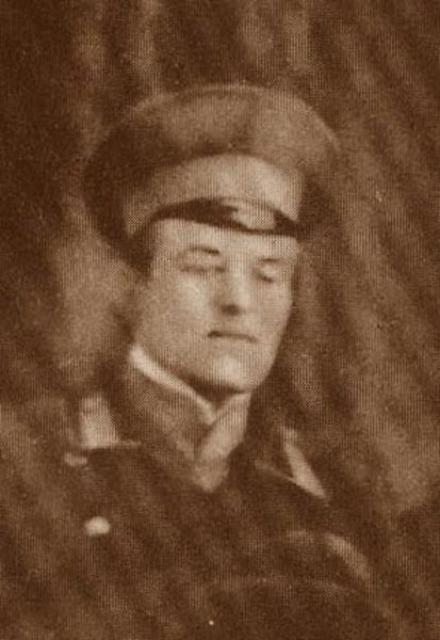
Nikolay Burlyuk
 Ukraine
Biography of Nikolay Burlyuk
Nikolay Burlyuk, a Russian poet and prose writer, was born into a family of estate managers and agronomists. His brothers, David and Vladimir, as well as his sister Lyudmila Burlyuk-Kuznetsova, were prominent figures in Russian futurism. Nikolay attended the Kherson Male Gymnasium and later the Saint Petersburg University, where he studied at the Faculty of Physics and Mathematics and the Agronomy Department.
Literary Career
Unlike his siblings, Nikolay never pursued a career as an artist, but he actively published in the publications of the cubo-futurists, such as "Studio of Impressionists," "Judges' Garden," and "Slap in the Face of Public Taste." However, his poetic style was fundamentally different from the deliberately "coarse," urban, and wordplay-focused aesthetics of David Burlyuk, Kruchenykh, and Mayakovsky. Nikolay's poetry was characterized by impressionistic imagery, portrayal of "dreams," mythological symbols, and a focus on musicality, which aligned him more closely with Elena Guro among the futurists. Like Guro, he also wrote lyrical prose, including works such as "The Deaf-Mute," "Artemis without Dogs," and "Escaped Muses."
Nikolay Burlyuk was also the author of theoretical articles, such as "Poetic Principles" and "Supplement to Poetic Counterpoint." He showed an interest in Acmeism and participated in the meetings of the "Guild of Poets." He was friends with Nikolay Gumilev. In 1914, he refused to sign the manifesto of the futurists titled "Go to Hell," which characterized Acmeists using offensive language.
Later Life and Death
In the following year, Burlyuk was published for the last time in the almanac "Spring Counteragency of Muses" in 1915 and disappeared from the literary scene forever. In 1916, he was mobilized into active military service and served on the Romanian front after completing officer training school in 1917. He later served in various armies during the time of the Russian Civil War in Ukraine, depending on which side's mobilization he fell under.
In 1919-1920, Burlyuk evaded any form of mobilization. In December, after the end of the Civil War, he registered in the Red Army in Kherson as a former officer, but he was arrested and sentenced to execution on December 25, 1920, by the "troika" of the 6th Army for preventive purposes, with the aim of "cleansing the RSFSR from suspicious individuals who could raise their weapons at any moment to suppress the power of the workers and peasants." The sentence was carried out on December 27, 1920. The circumstances of Nikolay Burlyuk's death remained unknown for a long time and were only published in 2001. David Burlyuk, who had emigrated to the United States and presented himself as a "friend of the USSR" and the "father of Russian futurism," was aware of his brother's execution but likely kept this fact hidden to avoid damaging the reputation of his family in the Soviet Union.



