Nikolay Dmitrevskiy
 China
China- Early Life and Education
- Artistic Journey in Vologda
- Literary-Philosophical Imagery
- Moscow and the Moscow School of Woodcut
- Repression and Legacy
Early Life and Education
Nikolai Pavlovich Dmitrevsky was born in 1890 into a Russian consular family in Hankou, China. His family hailed from Vologda, where young Dmitrevsky was brought at the age of five. In 1906, he enrolled in the newly established drawing classes at the Northern Circle of Fine Arts Enthusiasts in Vologda. From 1907, he studied at a private gymnasium in Saint Petersburg, followed by the Drawing School of the Society for the Encouragement of Arts and the private studio of the renowned graphic artist D.N. Kardovsky.
Artistic Journey in Vologda
After moving to Moscow in 1911, Dmitrevsky entered the Moscow School of Painting, Sculpture and Architecture. However, the outbreak of World War I interrupted his studies, as he was drafted into the army as a junior lieutenant. Returning to Vologda after demobilization in 1918, Dmitrevsky embarked on a prolific decade of artistic activity. He taught at the State Free Art Workshops and served as head of the department of museums and the protection of art and antiquities for the Vologda provincial executive committee.
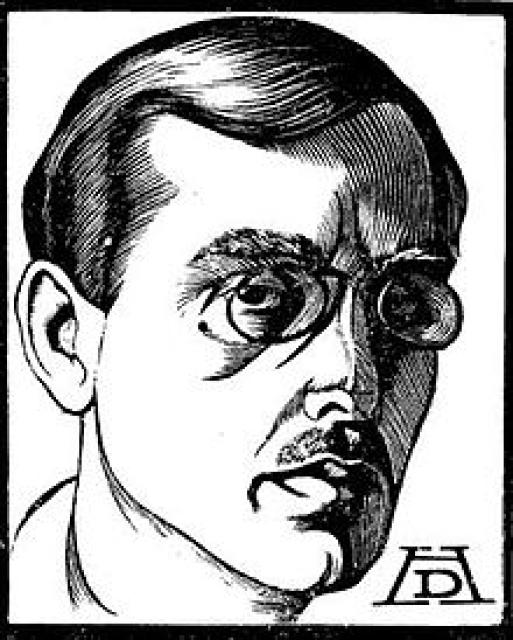
During the 1920s, Dmitrevsky's graphic work flourished. He designed covers for numerous local magazines and illustrated books ranging from scientific treatises to poetry and local history. In 1922, he published two albums of engravings, "In Memory of Alexander Blok. Theater" and "Old Vologda" (co-authored with I.I. Varakin), which gained significant recognition in Russian graphic art. His illustrations for Blok's lyrical plays remain the only visual interpretation of their complex and nuanced world.
Literary-Philosophical Imagery
Boldness of thought and the pursuit of complex, literary-philosophical imagery characterized Dmitrevsky's early works. He gradually refined his style, moving away from the angularity and mannerisms of his earlier compositions towards a more austere and concise form of expression. As a serious book illustrator, Dmitrevsky created notable series of wood engravings for works by Émile Verhaeren and Alexander Blok.
Moscow and the Moscow School of Woodcut
In 1927, Dmitrevsky relocated to Moscow, where he continued his work as a book designer for major publishers, including Molodaya Gvardiya, Academia, Izogiz, and Federatsiya. His late-period works included the renowned illustrations for Tommaso Campanella's "The City of the Sun."
Repression and Legacy
Dmitrevsky's life was tragically cut short when he was arrested in October 1937 and executed on January 2, 1938. Despite his untimely demise, his graphic art left an enduring mark on Russian culture. His works adorn the pages of influential Soviet editions of Pushkin, Blok, Herzen, and ancient Greek and Roman poets. They have become part of prominent collections in both Russian and international museums.