Nikolay Duhov
- Nikolai Leonidovich Dukhov: A Brilliant Engineer
- Early Career and the Leningrad Period
- Armor Development and the Kirovets Tank Factory
- Wartime Contributions
- Post-War Career
- Director and Scientific Leader
- Accomplishments and Legacy
- Three times Hero of Socialist Labor (1945, 1949, 1954)
Nikolai Leonidovich Dukhov: A Brilliant Engineer
Early Life and EducationBorn in the village of Veprik, Ukraine, in 1904, Nikolai Leonidovich Dukhov's family can be traced to impoverished nobility. The son of a medical assistant, he attended rural and classical schools where he excelled in foreign languages. In 1920, Dukhov graduated from the United Labor School.
Early Career and the Leningrad Period
From a young age, Dukhov held various positions, including census taker and manager of a reading room. In 1925, he joined the Chupakhovsky Factory as a sugar beet cutter. Later, he transferred to the technical and norming bureau, demonstrating his engineering aptitude.
In 1928, Dukhov received an opportunity to pursue higher education at the Kharkiv Geodetic and Land Management Institute. After completing his preparatory studies, he enrolled in the Leningrad Polytechnic Institute's Mechanical Faculty, where he graduated in 1932 as an engineer specializing in tractors and automobiles.
After graduating, Dukhov began his career at the Krasny Putilovets Plant (later the Leningrad Kirov Plant), where he rose from engineer to Deputy Chief Designer. He contributed to the mass production of the "Universal" tractor, the "Leningrad-I" automobile, and a heavy lifting crane.
Armor Development and the Kirovets Tank Factory
In 1936, Dukhov's expertise in auto-tractor engineering led to his involvement in armor development. He joined the Special Design Bureau-2 of the Kirov Plant and played a pivotal role in establishing a unified methodology for calculating the traction and durability of tanks.
He later led a design team that модернизировал the T-28 tank. In late 1938, Dukhov's team completed this project, including the design of a new side transmission for the tank, which he personally developed.
Inspired by the need for a new tank with anti-artillery armor, Dukhov proposed the technical design for the KV-1 heavy tank in late 1938. Serial production of the KV-1 began at the Kirov Plant in 1939.
Wartime Contributions
In 1941, the Leningrad Kirov Plant gradually evacuated to Chelyabinsk, where the Chelyabinsk Tractor Plant began producing KV tanks. Dukhov relocated to Chelyabinsk and became Chief Designer of Department No. 3.
As Deputy Chief Designer of the renamed Chelyabinsk Kirov Plant, Dukhov oversaw the establishment of assembly line production for KV tanks. He also led the development of their modifications and self-propelled artillery mounts.
Under Dukhov's guidance, the Kirov Plant produced the KV-1S, KV-85, IS-1, IS-2, IS-3, and IS-4 heavy tanks. Other prototypes, such as the KV-13, were also developed under his leadership.
Post-War Career
After the war, Dukhov supervised the development of the new S-80 ("Stalinets-80") tractor, featuring an enclosed cabin. In 1948, he became involved in the Soviet atomic bomb project as Deputy Chief Designer of KB-11 (Arzamas-16).
Dukhov led the construction sector responsible for designing both the first Soviet plutonium warhead and the atomic bomb itself. He played an active role in the first Soviet atomic bomb test at the Semipalatinsk Test Site on August 29, 1949, and the first hydrogen bomb test on August 12, 1953.
Director and Scientific Leader
In 1954, Dukhov became Director, Chief Designer, and Scientific Leader of Branch No. 1 of KB-11 (now the VNIIA named after N. L. Dukhov), a position he held until his death in 1964.
He established the institute's main areas of expertise: nuclear warheads for strategic and tactical nuclear weapons systems, electrical and neutron initiation systems for nuclear warheads, automation devices for nuclear warheads, and standardized control and measuring equipment.
Over the next ten years, Dukhov's leadership resulted in the development of three generations of automation blocks, the first generation of nuclear warheads for seventeen different carriers (including the R-7 ballistic missile, T-5 torpedo, and early cruise missiles), and a wide range of electromechanical devices for these warheads.
Dukhov was also instrumental in developing three generations of control and measuring equipment: oscillographic, compact non-oscillographic, and automated with digital recording. He is widely regarded as the founder of the design school for nuclear warheads.
Accomplishments and Legacy
Nikolai Leonidovich Dukhov was a brilliant engineer and inventor, receiving numerous awards and recognitions:
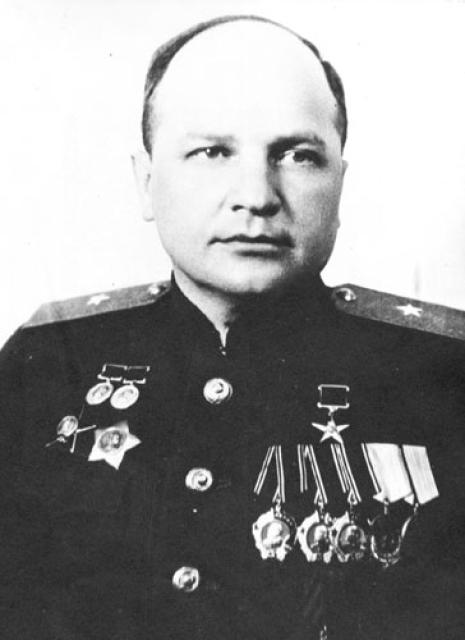
Three times Hero of Socialist Labor (1945, 1949, 1954)
Corresponding Member of the Academy of Sciences of the USSR (1953)Lenin Prize Laureate (1960)
Four Stalin Prizes (1943, 1946, 1951, 1953)
State Prize of the USSR (1954)
He established close professional relationships with prominent aviation and missile designers such as A. I. Mikoyan, V. N. Chelomey, and S. P. Korolev.
Alongside his engineering achievements, Dukhov was actively involved in education. From 1935 to 1940, he taught at the Leningrad Road Institute and the Mechanical Faculty of the Leningrad Polytechnic Institute.
In 1944, the Mechanics and Mechanical Engineering Institute was established in Chelyabinsk (later renamed Polytechnical University) with two faculties: Tank Engineering and Mechanical Technology. Dukhov was appointed Head of the Tank Engineering Department and Director of the State Examination Commission.
During his tenure at Branch 1 of KB-11, Dukhov emphasized the training of highly qualified scientific personnel. He initiated the establishment of an experimental laboratory and a dissertation council, resulting in the first three doctoral defenses in 1962.
Nikolai Leonidovich Dukhov's legacy lives on through the enduring achievements of the VNIIA and the impact of his contributions to the strengthening of the Soviet Union's defense capabilities. He is remembered as a visionary engineer, a pioneer in the development of nuclear weapons, and a dedicated educator.