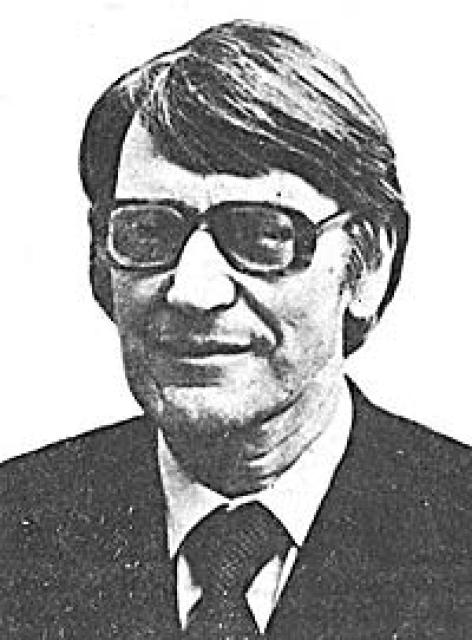
Nikolay Ermolovich
 Belarus
- Nikolai Yermolenko: A Pioneer of Belarusian Historical Thought
- Literary and Academic Career
- Underground Publishing
- Romantic Historiography
- Government Harassment
- Later Years
- Legacy
Nikolai Yermolenko: A Pioneer of Belarusian Historical Thought
Early Life and EducationNikolai Yermolenko, a renowned Belarusian writer and historian, was born in 1921 in Kozydakh (now Belarus). He adopted numerous pseudonyms throughout his career, including Symon Belarus, M. Yermolov, and M. Yarmolou.
Yermolenko's formal education began at Kozydanava Secondary School, which he completed in 1938. He then enrolled in the Belarusian Department of the Literary Faculty at the Minsk Pedagogical Institute, where he pursued his studies until the outbreak of World War II. Due to poor eyesight, Yermolenko was exempted from military service in the Soviet Army.
During the war, Yermolenko served as a teacher of Russian language and literature in Mordovia, Russia. Upon returning to Belarus in 1943, he continued his teaching career in the Vitebsk and Minsk regions. In 1946, he resumed his studies at the Pedagogical Institute, graduating in 1947. He later completed doctoral studies there.
Literary and Academic Career
Yermolenko's active literary career commenced in 1948. He contributed critical and literary essays, historical sketches, and original research to various newspapers and journals, including "Molodechno", "Naroch", "Zvyazda", "Literature and Art", and "Polimia".
In 1963, Yermolenko initiated the publication of the handwritten samizdat journal "Podsnezhnik" (Snowdrop), which ran for four issues until 1964. His research culminated in the publication of "Po sledam odnogo mifa" (In the Footsteps of a Myth) in 1968, initially circulated as samizdat before being officially released in 1989.
Underground Publishing
In 1975, using the pseudonym Symon Belarus, Yermolenko revived "Podsnezhnik" under the new title "Biesiedy" (Conversations). By 1976, he had produced approximately 50 issues, which were widely circulated and became a centerpiece of Belarusian underground literature.
Yermolenko sought to publish works that were denied access to the official press due to their political and social critiques. He prepared his materials in Minsk, printed them in Molodechno, and distributed them through intermediaries.
Romantic Historiography
Yermolenko emerged as the pioneer of a new Belarusian romantic historiography, challenging the prevailing Soviet interpretation of Belarus's history. His works placed Belarusian history in the context of broader European developments and emphasized the country's pre-Soviet heritage.
Government Harassment
Yermolenko's alternative historical narrative aroused the ire of authorities. The KGB repeatedly summoned him for questioning about his views on "the eternal independence of Belarusians." Despite the popularity of his works, they remained largely unpublished in official outlets until the era of perestroika.
Later Years
In his later years, Yermolenko continued to focus on the political history of ancient Belarus. He analyzed primary sources to refute the notion of a Lithuanian conquest of Belarusian lands and characterized the Grand Duchy of Lithuania as a Belarusian state.
However, Yermolenko's historical interpretations have not gained widespread acceptance among contemporary Belarusian historians. Nevertheless, his legacy lives on as a pioneer whose work paved the way for a more open and inclusive historical dialogue.
Legacy
Nikolai Yermolenko died in 2000, leaving behind a significant body of work that has profoundly influenced Belarusian historical thought. He remains recognized as a symbol of intellectual courage and a champion of Belarus's national identity.


