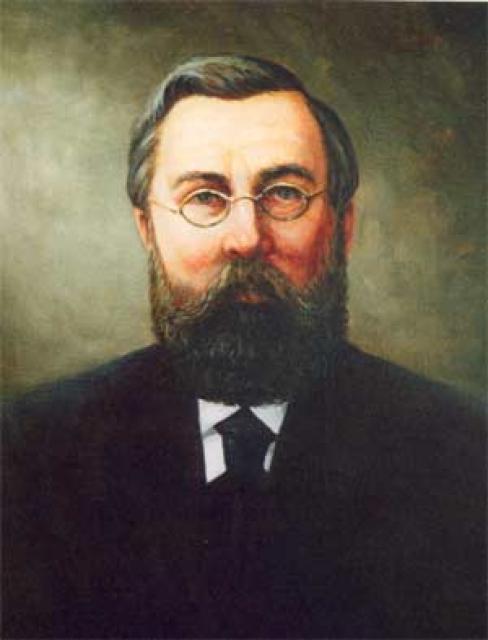
Nikolay Kutler
 Russia
- Political Involvement
- Member of the State Duma
- World War I and the February Revolution
- Economic Policy and Support for Kerensky
- October Revolution and Later Years
Nikolai Leonidovich Kutler was born into a noble family of landowners in the Tula province. He graduated from the law faculty of Moscow University in 1882. From 1892 to 1904, he held positions as Vice Director and Director of the Department of Direct Taxes in the Ministry of Finance.
Political Involvement
In 1904, Kutler was appointed Deputy Minister of Internal Affairs, and in 1905, he became Deputy Minister of Finance and Managing Director of the State Noble and Peasant Land Banks. In October 1905, he was appointed Minister of Agriculture in the Council of Ministers of Sergei Witte.
In March 1906, Kutler resigned due to conservative opposition to his proposed project of expropriating part of the landowners' lands for the benefit of landless peasants. He then joined the Constitutional Democratic Party (Kadets) and became a member of its Central Committee, authoring its agrarian program.
Member of the State Duma
Kutler was elected to the Second State Duma in 1907. In 1909, he became a member of the Third State Duma, where he vigorously defended the agrarian program of the Kadets. He also engaged in journalism and was one of the authors of the "New Encyclopedia Dictionary" published by Brockhaus and Efron in 1913.
World War I and the February Revolution
During World War I, Kutler was a member of the Central Military-Industrial Committee. On the eve of the February Revolution of 1917, he participated in meetings where support was expressed for the Workers' Group of the Central Military-Industrial Committee, which had been arrested by the Tsarist government.
After the overthrow of the autocracy, Kutler became Chairman of the Council of Congresses of Industrialists and Traders. He declared that "industry is happy to provide all its forces, resources, and experience at the full disposal of the new government."
Economic Policy and Support for Kerensky
Kutler played a key role in shaping the economic policies of the Provisional Government. He advocated for the regulation of relations between employers and workers, the organization of the industrial and commercial class on the principles of self-government, and the revision of mining and trade laws.
In May 1917, Kutler led a delegation of metallurgical and metalworking industry representatives to meet with the Provisional Government, demanding more decisive action against the workers' movement. He also blamed workers for industrial unrest and accused them of making "excessive demands."
As Chairman of the First All-Russian Congress of Representatives of Industry and Trade in June 1917, Kutler called for the consolidation of Moscow and Petrograd entrepreneurs under the financial and industrial circles of Petrograd. He saw the prevention of workers' control over production as a primary objective.
Kutler supported Alexander Kerensky's efforts to restore military discipline and opposed plans for state control of industry and tax increases. He also participated in the Moscow State Conference in August 1917, where he voiced concerns about the decline in industrial productivity and advocated for the reduction of government spending.
October Revolution and Later Years
Kutler opposed the October Revolution and was arrested but later released. He supported the White Army during the Russian Civil War and provided financial assistance to anti-Bolshevik forces.
In the Soviet Union, Kutler collaborated with the authorities and became a member of the Institute of Economic Research of the People's Commissariat of Finance. He also participated in the preparation and implementation of the monetary reform of 1922-24.