Nikolay Kuzanskiy
 Italy
ItalyNikolai Kuzansky: Biography of a Cardinal and Philosopher
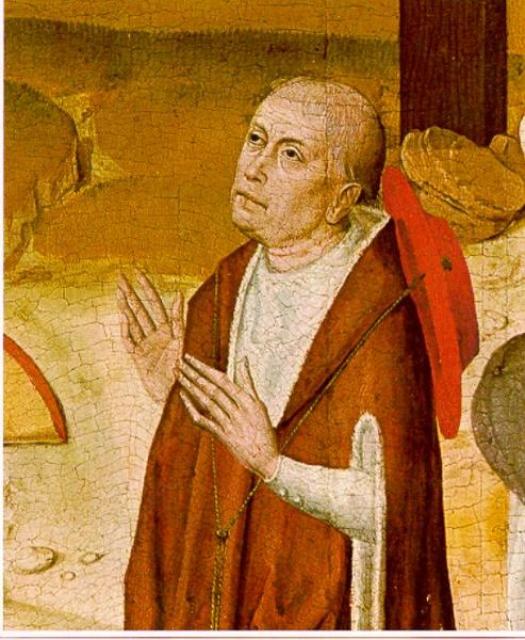
Nikolai Kuzansky, also known as Nicholas of Cusa, was a cardinal, theologian, philosopher, scientist, mathematician, and church-political figure. Born in Cusa on the Moselle River, he gained his nickname "Kuzansky" or "Cusanus" from his birthplace. Little is known about his childhood, except that his father was a fisherman and vineyard worker, and that Nikolai fled from home as a teenager. He was taken in by Count Theodoric von Manderscheid and possibly attended the school of the "Brothers of the Common Life" in Deventer, Netherlands. He continued his education at Heidelberg University in Germany and the School of Canon Law in Padua, Italy. In 1423, Nikolai obtained a doctorate in canon law. Upon returning to Germany, he pursued theology in Cologne. In 1426, shortly after his ordination as a priest, Nikolai became the secretary to Cardinal Orsini, the papal legate in Germany. Afterward, he became the parish priest of St. Florinus Church in Koblenz. During this time, Nikolai was introduced to the ideas of humanists, which influenced him. He was among the Roman Catholic priests who advocated for limiting the power of the Pope and strengthening the role of church councils. In his first work, "On Catholic Concordance," he expressed doubts about the authenticity of the "Donation of Constantine" and proclaimed the idea of popular will, which he believed had equal importance for the Church and the state. In 1433, he presented these ideas at the Council of Basel. However, by the end of the council, Nikolai switched sides and aligned with the Pope, likely doubting the possibility of reform. He soon joined the papal curia. In 1437, he was part of the papal delegation to Constantinople, which aimed to meet the emperor, patriarchs, and potential delegates from Eastern churches for a unification council between the Western and Eastern churches. The Greeks, fearing the Ottoman threat, increasingly sought unity. However, the council, opened in Ferrara and continued in Florence, did not achieve the desired results. On his journey from Constantinople to Cusa, Nikolai claimed to have received a divine revelation, which later became the foundation for his famous treatise "De docta ignorantia" ("On Learned Ignorance").
In 1448, Nikolai was appointed as a cardinal, and in 1450, he became the bishop of Brixen and the papal legate in Germany. In the 1450s, he traveled extensively, seeking to reconcile various Christian movements in Europe, including the Hussites, with the Catholic Church. In 1458, Nikolai returned to Rome and, as the Grand Vicar, attempted to reform the Church. He had hoped for success, as the new pope, Pius II, was his childhood friend, Aeneas Silvius Piccolomini. However, death prevented Nikolai Kuzansky from completing his plans. He contributed to the development of ideas that paved the way for natural philosophy and pantheistic tendencies in the 16th century. Unlike his contemporary Italian humanists, he focused more on philosophical questions related to the organization of the world, similar to the scholastics. Understanding God as the creator, the "form of all forms," the German thinker extensively used mathematical concepts and the dialectical doctrine of the coincidence of opposites to shed new light on the relationship between God and nature. Nikolai Kuzansky emphasized their connection, highlighting the infinity of God while acknowledging the limitations of any definitions. He interpreted the world as an "unfolding" of God. His core belief, which had pantheistic tendencies rooted in various philosophical foundations from Plato and Neoplatonism to medieval mysticism, was expressed in the formula "God in all and all in God." He also paid significant attention to the issue of humans' place in the world. By depicting all natural phenomena as interconnected, he saw humans as the "microcosm," charting their unique central role in the created world and their ability to comprehend it through the power of thought. Nikolai Kuzansky's name is also associated with important natural philosophical ideas about the movement of the Earth, which, although overlooked by his contemporaries, were later acknowledged. Far ahead of his time, he claimed that the universe is infinite and has no center; neither the Earth, nor the Sun, nor anything else occupies a special position. All celestial bodies consist of the same matter as the Earth and may be inhabited. Almost two centuries before Galileo, he asserted that all celestial bodies, including the Earth, move in space, and any observer has the right to consider themselves motionless. His works also include one of the earliest mentions of sunspots. Nikolai Kuzansky criticized the inaccuracies in the Julian calendar and called for calendar reform (this reform was extensively discussed and implemented only in 1582).
According to historians of science, Nikolai Kuzansky's astronomical works directly or indirectly influenced the views of Copernicus, Giordano Bruno, and Galileo. The German thinker also proposed several projects for interconnected church and political reforms. His proposals intricately intertwined a clear understanding of Germany's developmental needs, concerns about challenging the traditional authority of spiritual and secular princes, and a utopian vision of overcoming interconfessional disputes and achieving universal agreement among different faiths, including Christianity and Islam. The currents of humanistic character, independence of mind capable of questioning important church documents such as the Donation of Constantine and False Isidorian Decretals, coexisted in Nikolai Kuzansky with a commitment to the foundations of scholastic traditions and the position of a prominent Catholic hierarch, a cardinal who advocated for tolerance in words and enforced Rome's line of action.