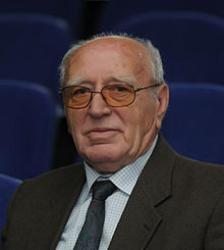
Nikolay Lysenko
 Ukraine
- Early Life and Family
- World War II and Education
- Career and Settlement in Brovary
- International Travel and Personal Life
- Public and Political Activism
- Legacy
Early Life and Family
Nikolay Lysenko was born on March 6, 1927, in the Voronezh region of Russia to a wealthy peasant-artisan family. However, in the early 1930s, the Communist regime labeled the Lysenko family as "kulaks" and repressed them. In 1931, they were forcibly deported to Siberia and the Kazakh SSR, where half of the family perished.
World War II and Education
During World War II, Lysenko enrolled in a vocational school for metalworking at the age of 16. After graduation, he worked as a teacher at the school. He was spared from combat duty due to his reserved status. Lysenko later passed the exams for the eighth grade and received a diploma.
In 1947, Lysenko completed high school and moved to Voronezh, where he studied agricultural economics at the agricultural institute. Graduating with honors in 1952, he volunteered to work in the Kiev region, specializing in soil science.
Career and Settlement in Brovary
In 1954, Lysenko settled in the Brovary district, where he worked as an agronomist and vegetable grower. He was granted a plot of land in Brovary the same year. In 1957, he began working at the research institute "UkrNIIGIM" in Kiev, later transferring to "Ukргипроводхоз" in 1962.
International Travel and Personal Life
During his time at "Ukргипроводхоз," Lysenko undertook two extended international assignments: in Tunisia from 1963 to 1964 and in Algeria from 1965 to 1967. He lived permanently in Brovary from 1965 onward. Lysenko married three times: Diana (1954-1958), Maya (1962-1969), and Nela Shcherbina (1981 until his death).
Public and Political Activism
In the mid-1980s, Lysenko began investigating mass graves in the village of Bykivnia. Based on eyewitness accounts and archival documents, he led a campaign to uncover the truth about the Stalinist terror buried there. Under pressure from irrefutable evidence, the government acknowledged in 1989 that Bykivnia held the remains of thousands of victims executed by the NKVD.
Lysenko published three books on the Bykivnia tragedy: "Bykivnia: Crime Without Repentance" (1996), "Bykivnia - Our Eternal Pain" (2009), and "In the Jaws of Communism" (2010). The latter chronicled his family's history and reflected on the suffering of the Ukrainian people under Soviet rule.
Lysenko was a founding member of the Ukrainian society "Memorial." He served as chairman of its executive committee for several years and later as chairman of "Memorial Kyivshchyna" for 15 years. In his later years, he was its honorary chairman. He was also involved in the Association of Former Political Prisoners and Repressed Persons, advocating for the preservation of their memory. Lysenko was the first chairman of the People's Movement of Ukraine in Brovary.
Legacy
Nikolai Lysenko's unwavering commitment to exposing the horrors of the Soviet regime left an enduring impact on the historical record. He was a courageous advocate for victims of political repression and played a pivotal role in establishing the Bykivnia memorial as a site of national remembrance and reconciliation.
In Brovary, Lysenko was a respected figure who served as a municipal council member on three occasions. He also established a museum of Ukrainian heritage in his home, preserving the cultural identity of his people. On March 1, 2014, Lysenko and his wife, Nela Shcherbina, tragically lost their lives in a road accident in Brovary. Their memory continues to inspire subsequent generations to stand against tyranny and fight for historical truth.