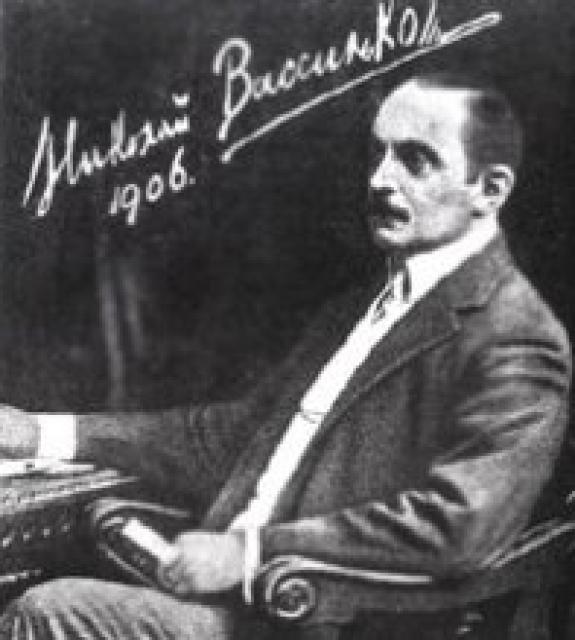
Nikolay Vasilko
 Austria
- Early Life and Education
- Political Career in Bukovina
- Deputy in the Austro-Hungarian Parliament
- Controversies and Collaborations
- World War I and Ukrainian Independence
- Minister in the Ukrainian People's Republic
Early Life and Education
Nikolai Vasilevich was born on March 25, 1868, in the village of Lukavets, now known as Lukovtsy, in the Bukovina region of Austria-Hungary. His father, Baron Nikolai Vasilevich, was a wealthy Romanian landowner, while his mother was a Romanian Armenian.
Nikolai received his education at the Theresianum, a prestigious academy in Vienna. During his studies, he became a member of the Bukovina Student Association. By the time he graduated, he was fluent in Romanian, German, and French, and had established connections with the Austrian aristocracy.
Political Career in Bukovina
After his parents' untimely deaths, Nikolai inherited a substantial fortune at the age of 24, which he quickly squandered. He initially pursued a career in Romanian politics but was unsuccessful. He then turned his attention to the Rusyn community in Bukovina.
Initially, Nikolai aligned himself with the "Old Rusyn" party, which advocated for the unity of Rusyns with Belarusians and Russians. However, as the Ukrainian nationalist movement gained momentum in Bukovina, Nikolai transitioned to the "Ukrainophile" camp, becoming a leading figure alongside Stefan Smal-Stockyi.
Deputy in the Austro-Hungarian Parliament
In 1898, Nikolai was elected a deputy to the Austro-Hungarian Parliament and the Bukovina Diet. Despite his initial lack of proficiency in the Rusyn language, he relied on an interpreter to communicate with constituents. Nikolai was re-elected in subsequent elections until the outbreak of World War I.
Controversies and Collaborations
Nikolai's career was marked by both controversy and collaboration. He abused his position as a deputy by exploiting financial resources and engaging in real estate scams. Despite his shady dealings, he played a significant role in combating "Russophile" organizations and individuals in Bukovina.
World War I and Ukrainian Independence
With the outbreak of World War I, Nikolai co-founded the Main Ukrainian Council, which later became the All-Ukrainian Council. He played a crucial role in organizing the Ukrainian Sich Riflemen and participating in the Brest-Litovsk negotiations.
Minister in the Ukrainian People's Republic
After the Ukrainian People's Republic was declared, Nikolai was appointed as Minister and Ambassador to Switzerland. In 1923, he was transferred to Germany as Ambassador, where he remained until his death in 1924.