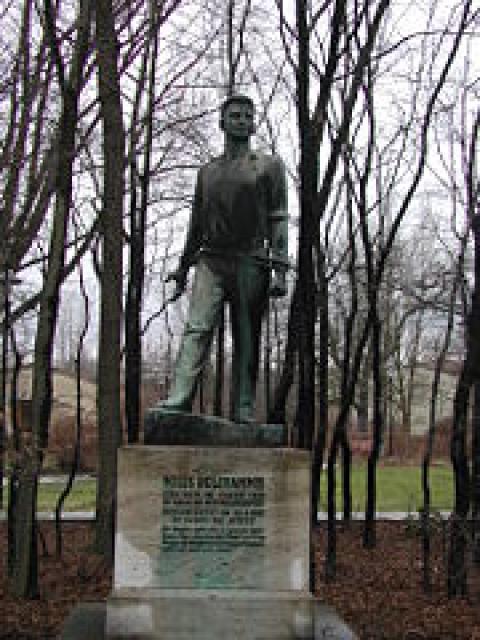
Nikos Beloyannis
 Greece
- Early Life and Political Activism
- Incarceration and Resistance
- Military Leadership during the Civil War
- Return to Greece and Arrest
- Trial and Execution
- Legacy
Early Life and Political Activism
Nikos Beloyannis(1915-1952) was a prominent Greek political figure and an ardent anti-fascist. From 1935 onwards, he actively participated in the revolutionary movement, becoming a member of the Central Committee of the Communist Party of Greece (KKE).
Incarceration and Resistance
In the late 1930s, Beloyannis' resistance to the regime of Ioannis Metaxas led to his arrest and imprisonment in Nafplion. In 1941, he was handed over to the Nazi occupation authorities but escaped in 1943. He subsequently joined the Greek partisan movement, serving as a commissar in the Greek People's Liberation Army (ELAS) from 1943 to 1944.
Military Leadership during the Civil War
During the Greek Civil War (1946-1949), Beloyannis commanded an army group of the Democratic Army of Greece (DSE). Following the defeat of the DSE, he was among the last to leave the country.
Return to Greece and Arrest
In June 1950, Beloyannis returned to Greece to rebuild the KKE's organization in Athens. However, on December 20, 1950, he was apprehended by the authorities and charged with treason and espionage for the Soviet Union.
Trial and Execution
Beloyannis' trial, which commenced on October 19, 1951, became a trial of the dictatorship itself. He transformed the proceedings into a platform to expose the government's injustices, earning him worldwide recognition as the "Man with the Carnation." Despite national and international protests, he was sentenced to death and executed on March 30, 1952.
Legacy
Beloyannis' sacrifice and unwavering resistance have left an enduring legacy. In Hungary, the town of Beloiannisz was named in his honor, serving as a haven for exiled Greek political refugees. His name remains synonymous with resistance against tyranny and the struggle for a just society.


