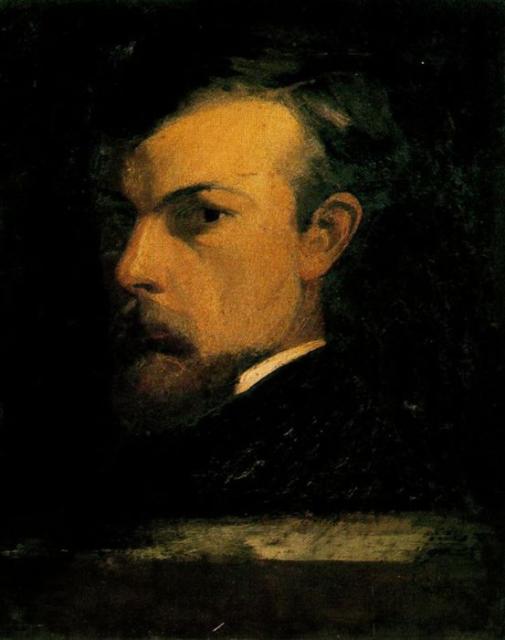
Odilon Redon
 France
Biography of Odilon Redon
Odilon Redon was a French symbolist artist and is considered one of the founders of symbolism as an artistic movement. He was born in Bordeaux, Aquitaine, into a fairly wealthy family. He was given the nickname "Bertrand-Jean" by his mother, Odile. Redon began drawing at a young age, and by the age of 10, his works gained some recognition at a school level. At the age of 15, Redon started studying drawing under professional teachers, but later switched to architecture at the insistence of his father. Unfortunately, he was unable to enter the École des Beaux-Arts in Paris, which put an end to his architectural aspirations. However, he did take drawing lessons from Jean-Léon Gérôme for a while. His younger brother, Gaston Redon, succeeded where he failed and became a well-known architect.
Returning to Bordeaux, Redon turned to the study of sculpture under the guidance of Rodolphe Bresdin. It is believed that his extreme self-doubt greatly contributed to his relatively low popularity as an artist. Rumor has it that in 1868, one of his works was almost approved by the Paris Salon commission, but Redon, panicked, withdrew his painting at the last moment. In 1870, Redon temporarily left art and joined the army to participate in the Franco-Prussian War. Surprisingly, the military actions had a positive effect on the artist – his self-doubt practically disappeared.
After the war, Redon moved back to Paris and during this period, he mainly focused on lithography and charcoal drawings. He referred to the works from this period as "noirs" or "black" works. His work only gained recognition in 1878 when the public admired his "Guardian Spirit of the Waters". Shortly after, Redon released his first collection of lithographs, called "Dans le Rêve". The first surge of interest in Redon was not particularly strong. It wasn't until 1884 that he was remembered again when Joris-Karl Huysmans' cult novel "À rebours" was published. The main character of the novel, an aristocratic decadent, had an impressive collection of artworks, including works by Redon.
In the 1890s, pastels and oil paints became popular, and Redon abandoned his "black" drawings for a long time. His transition into the "colorful" world was successful, and in his new works, the artist was able to reveal himself in unexpected ways. In 1899, Redon managed to have a joint exhibition with the artists from the "Nabis" group, under the auspices of Paul Durand-Ruel.
In 1903, Odilon Redon received the Legion of Honor. In 1913, André Mellerio published a collection of Redon's lithographs and engravings, which were highly appreciated by the public. In the same year, the artist held his largest exhibition of his career at the New York Armory Show. Odilon Redon passed away on July 6, 1916, at the age of 76. In 2005, the Museum of Modern Art held a major exhibition of Redon's works, showcasing over 100 of the artist's pieces.


