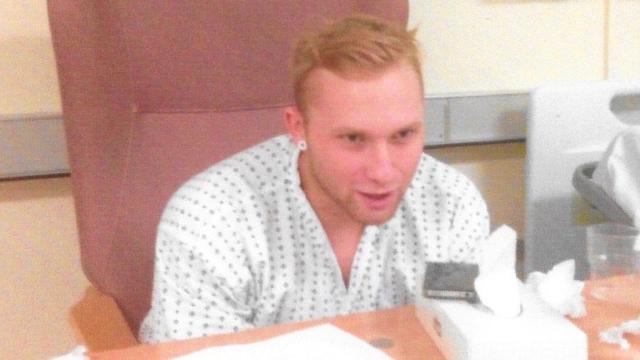
Oli Loyne
 Great Britain
- Oli Loizou: A Tragic Case of Bigorexia
- Understanding Bigorexia
- The Perils of Obsession
- Prevalence and Misdiagnosis
- Causes and Treatment
- A Survivor's Story
- Trice was admitted to a hospital and sought professional help.
- Steroids as a Symptom
Oli Loizou: A Tragic Case of Bigorexia
At the tender age of 20, Oli Loizou was cut short by a fatal heart attack. A year prior, he had narrowly survived a stroke and two heart attacks. Bigorexia, also known as muscle dysmorphia, leaves gym enthusiasts with an unwavering dissatisfaction with their appearance. Excessive weightlifting and steroid use fuel a cycle of depression, heart attacks, and suicide. The young Briton, whose dedication to steroids and extreme weightlifting is believed to have claimed his life, suffered from this debilitating disorder.
Understanding Bigorexia
Bigorexia is a mental illness characterized by an overwhelming preoccupation with becoming more muscular. Formally known as body dysmorphic disorder (BDD) or muscle dysmorphia, it is often referred to as "anorexia in reverse." While anorexics perceive themselves as overweight when they are actually underweight, bigorexics believe they appear too thin and frail, despite being highly muscular. It is estimated that as many as one in ten British gym-goers suffer from bigorexia, as reported by BBC's Newsbeat.
The Perils of Obsession
This distressing condition can spiral into depression and suicide. It may also lead individuals to take steroids, which are known to have potentially life-threatening side effects. Loizou's family had witnessed the devastating toll it had taken on him. His mother, Sarah, suggested that body dysmorphia may have stemmed from his insecurities about his height.
"A lot has been made of the fact that my son was short," she said. "He was 5ft 2in, a size that just happened to be small, so he wanted to bulk himself up as much as he possibly could.
"He didn't realize how far down the road he was going. He just couldn't see what he was doing to his body anymore... He just got stuck on the way that he thought he should look in his own head, to become bigger."
Prevalence and Misdiagnosis
Bigorexia affects both men and women, but an expert suggests that the issue is often under-recognized.
Rob Wilson, chair of the Body Dysmorphic Disorder Foundation, said, "We know that something like ten percent of men in gyms may experience muscle dysmorphia."
He believes that bigorexia is a growing problem but many are unaware of the condition and that there is little discussion about it.
"Muscle dysmorphia is an obsession with the idea that you're not big enough, that you don't have enough muscle," Wilson explained. "There are thousands and thousands who are hugely preoccupied with their appearance, who have very low self-esteem, and who have constant anxiety and worry.
"It can lead, in some cases, to extreme depression and despair and that can lead to suicide."
Wilson points to the increasing pressure on men to conform to a certain appearance in order to feel successful, strong, and attractive.
"We are seeing now more pressure on men to look muscular, to have that V-shaped body, to have the six-pack on show," he added.
Causes and Treatment
The exact causes of bigorexia remain uncertain. The National Health Service (NHS) uses the umbrella term "body dysmorphic disorder," which includes muscle dysmorphia. It may result from genetic or chemical imbalances in the brain.
Past experiences have also been implicated as a contributing factor, such as childhood physical or verbal abuse. Bigorexics are often reluctant to seek medical help, which can include cognitive behavioral therapy (CBT) and antidepressants.
A Survivor's Story
Adam Trice, a 31-year-old amateur bodybuilder from Shipley, West Yorkshire, shared his harrowing account of how his obsession to "sculpt the perfect body" nearly cost him his life.
Trice trained obsessively at the gym but felt it wasn't enough. He turned to steroids because "everybody else was doing it."
"I started off at 76kg. I wanted to get to 95kg. I got to 95kg and then I wanted to get to 110kg and then 120kg. You just keep wanting more and more. The bar gets raised every time."
Trice eventually lost his job, his girlfriend, and his home. Spiraling into a deep depression, he reached a point where he had dark thoughts of ending his life.
"I wasn't happy," he said. "I had no contentment in my life whatsoever. I couldn't deal with it any longer and I decided to end it. I was just in a very dark place."
Trice was admitted to a hospital and sought professional help.
"I've had a lot of counseling. I've done a lot of work on myself and learned a lot about myself. I've learned to love myself."
Steroids as a Symptom
The use of steroids itself can be a telltale sign of bigorexia. Steroids are intended to promote muscle growth, but the use comes with a litany of side effects.
Steroids can lead to hair loss, shrinkage of the testicles, and increased risk of heart and liver disease.