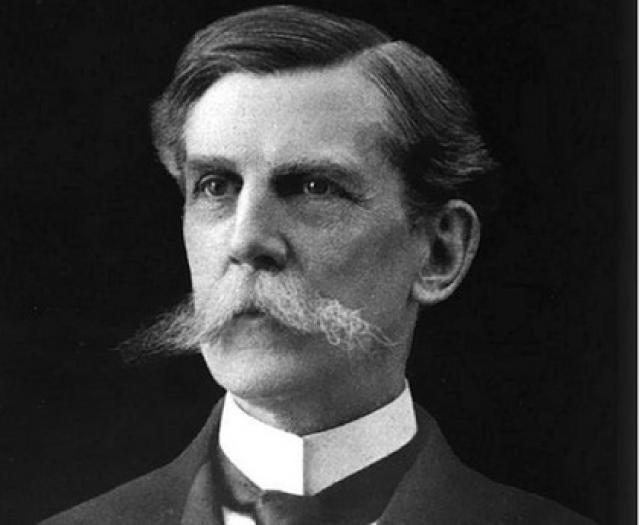
Oliver Wendell Holmes Sr
 USA
USABiography of Oliver Wendell Holmes Sr.
Oliver Wendell Holmes Sr. was an American physician, poet, and writer. He was born in Cambridge, Massachusetts, to Abiel Holmes, a minister and historian, and his second wife Sarah Wendell. As a child, Oliver suffered from asthma but compensated for his poor health with rapid development. He spent a significant amount of time in his father's library, where he discovered the works of John Dryden, Alexander Pope, and Oliver Goldsmith, inspiring him to write his own poetry.
At the age of 15, Oliver enrolled in Phillips Academy in Andover, Massachusetts. Although his father hoped he would pursue a career in law, Oliver was more interested in literature. After graduating from Harvard College, where he studied law, medicine, and literature, Oliver decided to pursue a career in writing rather than becoming a professional poet. He gained recognition for his poems, particularly those published in "The Collegian," a short-lived student journal.
In 1830, Oliver gained international fame when he wrote a passionate poem about the fate of the renowned English ship, USS Constitution, preventing its dismantling. Despite his literary success, Oliver chose to study medicine. He attended the Boston Medical College and later completed his medical degree at Harvard. He became a prominent figure in the medical field, joining various medical societies in Massachusetts and Boston.
Oliver's reputation was enhanced with the Boylston Prize from Harvard Medical School, which he received for his work on the merits of the stethoscope. Although he established his own medical practice, Oliver primarily focused on teaching and lecturing. In his lectures, he vehemently criticized pseudoscientific concepts such as astrology, alchemy, and homeopathy.
In 1843, Oliver published an article on puerperal fever, which challenged existing theories about the disease's origins. He presented substantial evidence that any physician who had encountered the disease must thoroughly sterilize their instruments, destroy contaminated clothing, and refrain from practicing for at least six months after contact with an infected patient. Despite initial disregard, several influential doctors eventually acknowledged Oliver's findings and failed to disprove them.
In 1846, Oliver coined the term "anesthesia" in correspondence with dentist William T. G. Morton, who used ether in his dental practice. Throughout his life, Oliver continued to write, surpassing his early poetic attempts. He published biographical works and medical essays alongside his poetry.
Oliver's personal life was marked by marriage to Amelia Lee Jackson in 1840. They had several children, but the death of his youngest son deeply affected him. He became less active in writing and socializing. In 1884, Oliver embarked on a trip to Europe with his daughter, where he met renowned scientists and writers. However, his wife's death in 1888 and the subsequent loss of his youngest daughter affected him deeply.
In his later years, Oliver's eyesight deteriorated, but he persisted in his creative endeavors. He outlived most of his friends and family, finding solace in his writing. Oliver Wendell Holmes Sr. passed away in his sleep on October 7, 1894.


