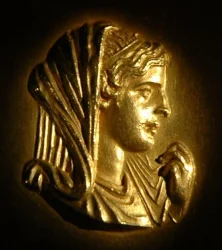
Olympias
Olympias was a princess of Epirus who became queen of Macedon through her marriage to Philip II and the mother of Alexander the Great. She was an influential figure in the Argead dynasty, active in court politics during Alexander’s campaigns and later in the succession struggles that followed his death. Ancient writers often portrayed her through dramatic and hostile stories, so the details of her character and private life remain difficult to establish with certainty.
Epirian princess and Macedonian queen
Olympias was the daughter of Neoptolemus, king of the Molossians, a people of Epirus. Around 357 BCE she married Philip II of Macedon, strengthening a political connection between the two neighboring kingdoms. She gave birth to Alexander in 356 BCE and later to a daughter, Cleopatra. Her marriage to Philip took place in a royal household where alliances, rival wives, and the question of succession carried enormous political weight.
Philip’s marriage to Cleopatra Eurydice, a Macedonian noblewoman, created new tension at court. Ancient sources connect the episode to a dispute between Alexander and his father, though their accounts differ in emphasis and reliability. After Philip was assassinated in 336 BCE, Alexander secured the throne and launched his campaign in Asia. Olympias remained an influential presence in Macedonian politics while he was away, but she competed for authority with Antipater, the regent Alexander had left in Europe.
Power after Alexander
Alexander died in 323 BCE without an adult heir. His son, Alexander IV, was born after his death, and the empire’s generals struggled over who would govern in the child’s name. Olympias initially withdrew to Epirus. In 317 BCE, she returned to Macedon with the support of Polyperchon, a rival to Cassander, and championed the rights of her grandson and the royal family.
Her forces defeated those of Eurydice, the wife of Philip III Arrhidaeus, and Olympias briefly held power in Macedon. She ordered the execution of Arrhidaeus and Eurydice and targeted supporters of Cassander. These actions weakened her position. Cassander’s forces captured her at Pydna, and she was put to death in 316 BCE, despite attempts to secure her safety through a trial.
Legacy
Olympias’s reputation was shaped by the political struggles of the Successor era and by later authors who described her as ambitious, fierce, or devoted to religious rites. Such portraits may reflect the biases of male writers as much as her own conduct. Her political actions nevertheless show that royal women could exercise real authority in Macedonian succession disputes. As Alexander’s mother and a determined defender of his son’s claim, she remained a consequential actor in the uncertain years after the conqueror’s death.