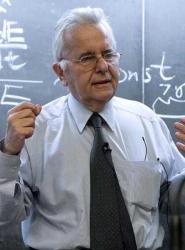
Oskar Klein
 Sweden
- Biography of Oscar Klein
- Contributions to Quantum Mechanics
- Theory of Compton Effect
- General Theory of Relativity and Gravity
- Recognition and Awards
Biography of Oscar Klein
Oscar Klein was a Swedish theoretical physicist and a member of the Swedish Academy of Sciences since 1945. He was born in Stockholm and completed his education at Stockholm University in 1922. From 1927 to 1928, Klein worked at the Institute for Theoretical Physics in Copenhagen, and from 1928 to 1962, he was a professor at Stockholm University, where he made significant contributions to various fields of physics.
Contributions to Quantum Mechanics
Klein's works primarily focused on quantum mechanics, quantum electrodynamics, elementary particle physics, general theory of relativity, cosmology, and statistical physics. In 1926, he formulated the simplest relativistic wave equation for particles with zero spin, known as the Klein-Fock-Gordon equation. In 1927-1928, Klein, along with P. Jordan and Y. Wigner, showed that the fundamental equation of non-relativistic quantum mechanics could be formulated in terms of field operators, known as the Jordan-Klein-Wigner operator theory of fields.
Theory of Compton Effect
In 1929, Klein collaborated with W. Nishina to develop the theory of the Compton effect, known as the Klein-Nishina equation. This theory explained the scattering of X-rays by electrons and was a significant advancement in understanding the interaction of radiation with matter.
General Theory of Relativity and Gravity
Klein also delved into the study of the general theory of relativity in connection with quantum theory. In 1928, he proposed the Klein-Kaluza theory of gravity, which aimed to unify gravitation and electromagnetism. His research also extended to the field of meson theory and particle systematics.
Recognition and Awards
Klein's contributions to physics were highly regarded, and he received numerous honors throughout his career. From 1953 to 1965, he served as a member of the Nobel Committee. In 1959, he was awarded the Max Planck Medal for his outstanding achievements in theoretical physics.