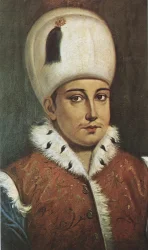
Osman II
Osman II, known in Turkish tradition as Genç Osman (“Osman the Young”), was an Ottoman sultan whose short reign ended in a revolt by soldiers in the capital. He became ruler as a teenager, led an inconclusive campaign against the Polish–Lithuanian Commonwealth, and tried to strengthen the sultan’s authority against powerful military groups. Deposed in 1622, he was imprisoned and killed, the first Ottoman sultan to die in a revolt by his own subjects.
A young sultan
Osman was born in 1604, the son of Sultan Ahmed I. When Ahmed died in 1617, Osman’s uncle Mustafa I succeeded him, but was deposed within months. Osman took the throne in 1618, still a teenager. His youth and inexperience left him dependent on court officials and military elites, whose interests often conflicted with the sultan’s.
His reign unfolded amid disputes over state finances, the influence of the Janissaries, and the Ottoman Empire’s wars on its borders. The Janissaries were an elite infantry corps with a powerful role in the capital’s politics as well as on campaign.
The Khotyn campaign and plans for change
In 1621, Osman personally led an Ottoman campaign against the Polish–Lithuanian Commonwealth. The siege of Khotyn (Chocim) ended without a decisive victory. A treaty restored the frontier, but the campaign’s difficulties and the sultan’s dissatisfaction with his troops contributed to tensions at court.
Osman considered changes to the military and the recruitment system. Sources suggest that he planned to travel to Anatolia and raise troops who would be more loyal to him, potentially reducing the Janissaries’ influence. The details and extent of his plans remain debated, and later accounts sometimes present them as a fully formed effort to abolish the corps. Even the possibility of such changes threatened groups whose power depended on the existing order.
Deposition and death
In May 1622, Janissaries and other soldiers in Istanbul rebelled. They deposed Osman and restored Mustafa I to the throne. Osman was taken to Yedikule Fortress, where he was killed on May 20, 1622. His death marked an unprecedented rupture in Ottoman political life: a reigning sultan had been removed and killed by a revolt within the empire.
Osman’s reign exposed the limits of a young ruler’s power in a political system where military factions could intervene directly in succession. His efforts to assert authority may have been shaped by genuine reform ideas, personal ambition, or both. Whatever their precise form, the plans helped provoke a crisis that ended his rule and demonstrated the Janissaries’ capacity to determine who occupied the throne.