Otto Hofmann
 Germany
Biography of Otto Hoffmann
Otto Hoffmann was born in 1896 in Innsbruck, Tyrol, Austria, into a family of wine merchants. He was still a schoolboy when World War I broke out. Without completing his education, he volunteered for the Bavarian Royal Army and served in the field artillery. In the spring of 1917, Hoffmann was promoted to the rank of lieutenant and attended pilot training courses. He then served as a communication officer and observer in the Austrian army on the Eastern Front. One day during an offensive, his plane was shot down and he was wounded and taken prisoner. After recovering, he managed to escape and, upon reaching German territory, re-enlisted in the Bavarian army. Hoffmann was awarded the Iron Cross First and Second Class for his combat merits, as well as numerous Bavarian medals.
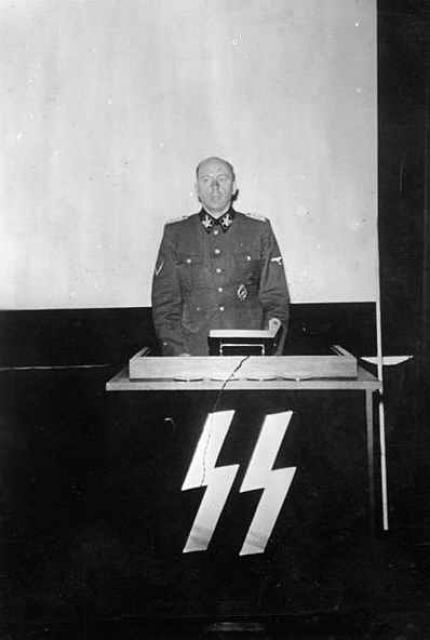
After the war, he worked in the family business and was involved in the wine industry until 1925. Joining the National Socialist German Workers' Party (NSDAP) in 1923, Hoffmann became a member of the SS in 1931. He held the rank of SS-Untersturmführer and combined his party work with wine trading. In 1933, he fully transitioned to the SS and obtained a position in the SS 'South' administration. He was promoted to the rank of Sturmbannführer and later Oberführer. By the mid-1930s, Hoffmann had already become the head of the SS administration in Hamburg and Magdeburg.
In 1937, he was transferred to Berlin, where he became part of the Main SS Office for Race and Settlement Affairs. His career continued to rise, and he soon attained the rank of Brigadeführer and later Gruppenführer. He also became the chief of the Main SS Office for Race and Settlement Affairs. Under his leadership, the "Germanization" of Poland and the Soviet Union took place, involving mass resettlements of indigenous populations and the settlement of Germans in these territories. In 1942, Otto Hoffmann participated in the Wannsee Conference, where the so-called "Final Solution to the Jewish Question" was decided.
In March 1943, Hoffmann left his position as chief of the Main SS Office for Race and Settlement Affairs and became the police chief and commander of the SS 'Southwest' administration in Stuttgart. In 1944, he was awarded the Golden Party Badge of the NSDAP, an honorary distinction of the highest political ranks within the party.
Towards the end of the war, Otto Hoffmann surrendered and was taken into captivity. In the Nuremberg Military Tribunal's trial on racial crimes, he was sentenced to 25 years in prison at Landsberg prison in the spring of 1948. In April 1954, Hoffmann was pardoned and released. After his release, he resumed his involvement in the wine trade.