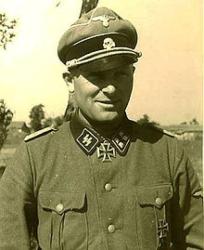
Herbert Otto Gille
 Germany
Biography of Herbert Otto Gille
Herbert Otto Gille was a German military officer, SS-Obergruppenführer, and Waffen-SS general. Born in the resort town of Bad Gandersheim, Gille joined the Prussian Royal Corps in Bensberg in 1910, at the age of thirteen. Four years later, he was transferred to the Berlin Cadet Corps in Gross-Lichterfelde. After completing his education and service, Gille was promoted to the rank of Second Lieutenant in the 30th Field Artillery Regiment.

During World War I, Gille served in the 55th Reserve Regiment and participated in combat. In January 1915, he was promoted to the rank of Lieutenant. After the 55th Reserve Regiment was disbanded, Gille returned to the 30th Regiment. He was decorated with the Iron Cross First and Second Class for his actions during the war. In March 1919, he was promoted to the rank of First Lieutenant.
After his military service, Gille worked in agriculture and later entered the automobile trading business. On May 1, 1931, he joined the National Socialist German Workers' Party (NSDAP) and six months later became a member of the SS. Gille quickly rose through the ranks of the SS and by November 1944, he held the rank of SS-Obergruppenführer and General of the Waffen-SS.
Gille faced some setbacks in his party career, including being expelled from the SS and NSDAP for his involvement in a project to overthrow the government of Brunswick. However, he managed to have the decision overturned and was reinstated. From November 1940, Gille commanded the 5th SS Artillery Regiment in Felix Steiner's 'Wiking' Division.
Gille's leadership skills were recognized during his actions on the Mius River, for which he was awarded the German Cross in Gold. In 1942, he captured Rostov-on-Don and participated in the breakthrough to the Kuban region, the battles in Tuapse, and the attack on Maikop. On October 8, 1942, Gille was awarded the Knight's Cross of the Iron Cross for his achievements.
Gille temporarily commanded the 'Wiking' Group and on May 1, 1943, he officially replaced Steiner in this position. Under Gille's command, the 'Wiking' Division played a crucial role in the German forces' organized retreat after the defeat at Kursk, earning him Oak Leaves to the Knight's Cross. In October 1943, the division was reformed into a tank division and sent to reinforce German positions in Ukraine.
Gille was known for his strict discipline and his efforts to build a sense of camaraderie among his subordinates. One of the most important episodes in Gille's career was the Korsun Pocket. In February 1944, Gille and his troops were surrounded after fierce fighting near Korsun-Shevchenkivskyi. Despite the offer to surrender, Gille vehemently rejected it and organized a breakout. The effectiveness of this breakout remains a subject of debate among Soviet and Western historians. Nevertheless, Gille and a portion of his troops managed to escape. For his actions at Korsun, he was awarded the Knight's Cross with Oak Leaves and Swords on February 20, 1944.
After the war, Gille was arrested in May 1948. He returned to Germany in 1949, where he was once again detained as an SS member. However, his imprisonment included the time he spent in captivity. After his release, Gille worked as a civil servant in Hanover.