Paavo Talvela
 Finland
- Biography of Paavo Talvela
- Early Career
- Rise in the Military
- During the Soviet-Finnish War
- Later Career and Legacy
Biography of Paavo Talvela
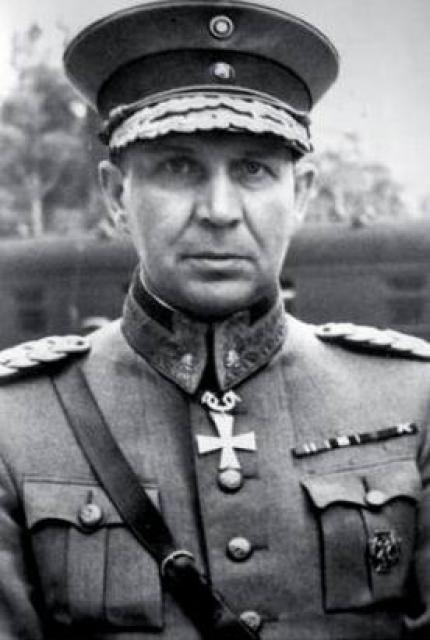
Paavo Talvela (19.2.1897, Helsinki - 1973) was a Finnish military figure and infantry general (1966).
Early Career
In 1916, Talvela fled to Germany where he joined the 27th Prussian Jaeger Battalion, primarily composed of Finns. He returned to Finland in 1918 and actively participated in the battles against the Reds. He became the commander of the 2nd Battalion of the Porin Regiment and was promoted to the rank of major in 1918. In 1919, he led a military expedition with the goal of capturing Karelia. After the signing of a peace treaty in 1920, Talvela refused to withdraw his troops from Karelia and conducted a guerrilla war for two years. In 1922, he returned to Finland with remnants of his unit and was welcomed as a national hero.
Rise in the Military
After graduating from the Staff Academy in 1926, Talvela was appointed as the commander of the elite Jaeger Regiment (Savo). In 1927, he became the Chief of the General Staff. Talvela, a brilliant officer with wide connections in the Finnish army leadership (Marshal Carl Gustaf Emil Mannerheim considered him his adoptive son), rapidly climbed the ranks. He held an anti-Russian position and was a staunch nationalist. In 1929, he founded the Lapua Movement, which aimed to combat communism in Finland. However, his active political activities led to his dismissal from the armed forces. Talvela then successfully pursued a business career, serving as the chairman of the Cellulose Union of Finland and as an authorized agent for procuring weapons for the army. He accumulated a large fortune. Following an unsuccessful attempt at a coup in 1932, the Lapua Movement was banned.
During the Soviet-Finnish War
In mid-1939, Talvela returned to service as the assistant chief of the Military Economics Department of the Ministry of Defense and as the chief of the Arms Council Staff. When the Soviet-Finnish War broke out in 1939-40, Talvela took command of a separate operational group on December 8th. His group, consisting of seven battalions, was tasked with stabilizing the position on the northern flank of General V. Haglund's IV Corps. On December 12th, Talvela launched a counterattack against the 139th Soviet Division, surrounded it, and completely destroyed it. He then defeated the abandoned 75th Soviet Division. Within 10 days, he captured 600 prisoners, along with 60 tanks, 31 artillery pieces, and 220 machine guns, despite losing up to 25% of his personnel. On February 19, 1940, he was appointed as the commander of the III Corps, which operated on the Karelian Isthmus. He successfully defended against the advancing forces of the 13th Soviet Army, preventing them from breaking through to Keksgolm. Talvela was considered one of the most promising Finnish commanders.
Later Career and Legacy
After the war, Talvela was tasked with overseeing the fortification of the port of Petsamo. In September 1940, he traveled to Berlin as the personal representative of Mannerheim and conducted negotiations with representatives of the German General Staff, including discussions on the supply of weapons to the Finnish army. An agreement was reached on joint cooperation between the General Staffs. Talvela made several subsequent trips to Germany. Thanks to his actions in the "Barbarossa" plan, the Finnish army was allocated an active role in the future war instead of a passive one. In June 1941, he was appointed as the commander of the VI Corps, which included the 5th and 11th Divisions and the 1st Jaeger Brigade. The corps became part of the Karelian Army. Talvela played a leading role in the Finnish offensive in Eastern Karelia. In July 1941, he broke through the defense of the 71st Soviet Division and on July 14th, penetrated the front of the 7th Soviet Army, reaching the Soviet-Finnish border of 1939. On September 4th, Talvela's corps (reinforced by two divisions from the Karelian Isthmus and Hanko) launched an offensive on the Svir River direction, breaking through the defenses of the Southern Operational Group and captured Olonets on September 6th. He also contributed to the capture of Petrozavodsk by General Haglund's troops and later participated in battles north of Lake Onega. In early 1942, Talvela was appointed as the commander of the Karelian Army, which was no longer engaged in active combat but rather in passive defensive battles. In mid-1942, he was sent to Berlin as a representative of the Finnish Army Commander-in-Chief at the Supreme Command of the Wehrmacht. In late June 1944, when Soviet forces launched a large-scale offensive, Talvela was urgently recalled to Finland and appointed as the commander of the II Corps (also known as the Masel Operative Group), deployed between Lake Segozero and Lake Onega. On June 14th, he replaced General L. Hägglund as the head of the Olonets Operational Group. Skillfully withdrawing his troops, he entrenched them on a fortified line along the Svir River. However, he could not withstand the attack of the 32nd Soviet Army and on August 9th, retreated to the old defensive line. From August 1st to September 7th, 1944, he once again served as a representative with the German command. In 1946, Talvela retired and went to Latin America, where he resumed his business activities. In 1949, after accumulating a substantial fortune, he returned to Finland. He served on the boards of many companies and in 1951, he founded and led the Society of Marshal Mannerheim's Memory.