Paul Baum
 Italy
ItalyBiography of Paul Baum
Paul Baum was an artist, draftsman, and graphic artist, and one of the leading representatives of post-impressionism in Germany. He began his artistic career as a floral painter on ceramics, working at the royal porcelain factory in his hometown. He then studied under Friedrich Preller the Younger at the Dresden Academy of Fine Arts. In 1878, Baum moved to Weimar, where he studied at the local School of Arts under the artist Theodor Hagen. During his studies, he traveled to Northern Germany, Flanders, and Holland.
In 1888, Baum lived in Munich and joined the artists' colony in Dachau, where he befriended Karl Bantzler and Max Stremler. In March 1890, he made a trip to Paris with Stremler, where both artists became acquainted with the works of French Impressionists. Shortly after, Baum left Dachau and settled in the Belgian city of Knokke-Heist. Here, in 1894, he met Camille Pissarro and the Belgian pointillist painter Theo van Rysselberghe.
In the same year, Baum moved to Dresden and participated in the art movement Dresden Secession. In 1895, the artist relocated to Sliedrecht in the Netherlands, where he lived until 1908, occasionally making trips to Italy, Southern France, Turkey, and Berlin, where he participated in the Berlin Secession exhibition in 1902. In 1909, Baum received the Villa Romana Prize, after which he lived in Italy, mainly in Tuscany, for four years.
With the outbreak of World War I, the artist returned to Germany and became a professor at the Dresden Academy of Fine Arts in 1914. From 1918, he was a professor of landscape painting at the Kassel Academy of Fine Arts. After 1924, Baum lived predominantly in San Gimignano, where he died from pneumonia in 1932.
Artistic Style and Works
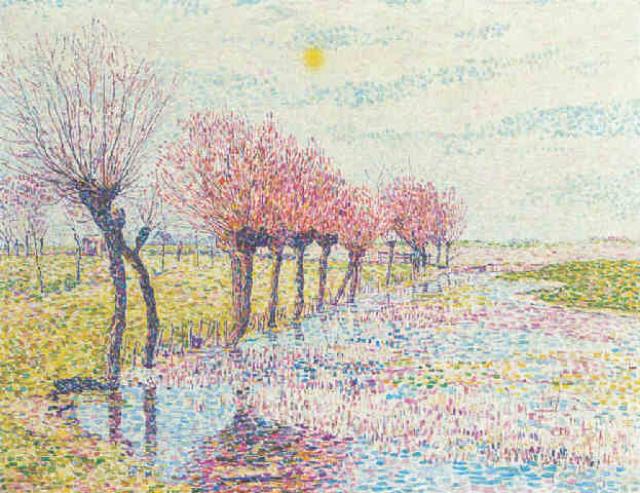
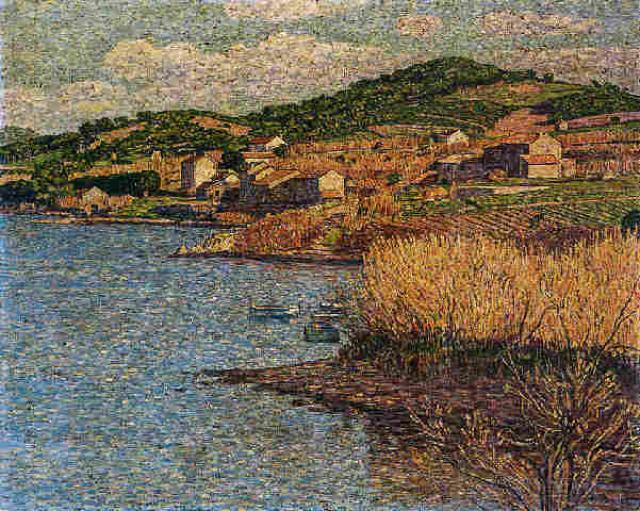
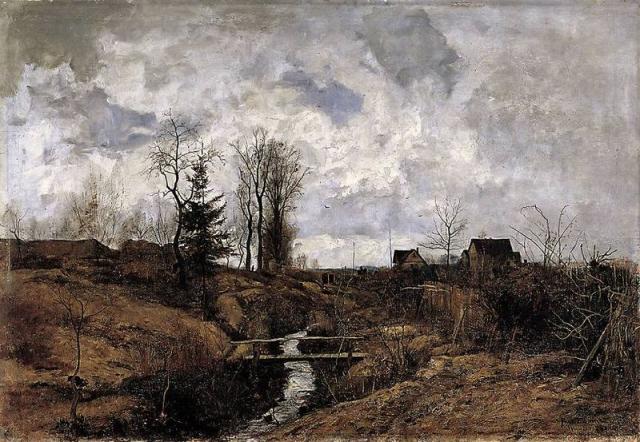
Baum's early works were executed in the style of the Barbizon School. After visiting Paris, the artist began to use lighter tones typical of the Impressionists. Influenced by Theo van Rysselberghe, Baum developed his own post-impressionist style of painting starting from 1900. His most famous works are landscapes from Flanders, Holland, and Zeeland, depicting canals and fields protected from the sea by dikes, executed in a pointillist manner. In addition to oil paintings, Paul Baum also created watercolors and left behind a multitude of drawings, engravings, and color lithographs.




