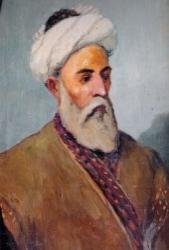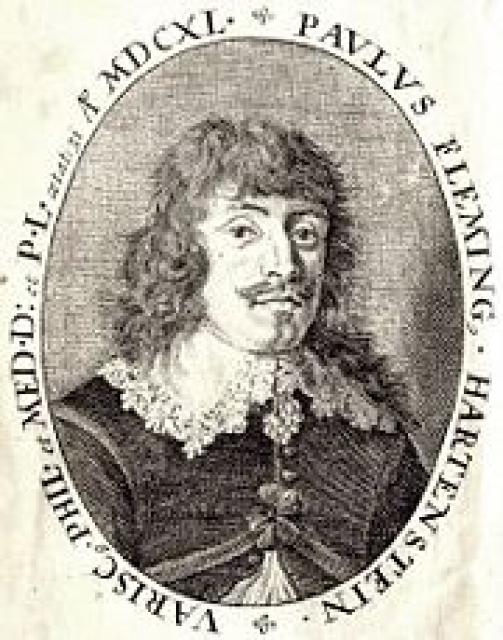
Paul Fleming
 Germany
Biography of Paul Fleming
Paul Fleming, a German poet and a trained physician, was one of the most prominent lyricists of the German Baroque period. He was born in the town of Hartenstein in Saxony, the son of a local pastor. He received home education initially and then attended school in Mittweida. At the age of 14, he was admitted to the prestigious Thomasschule (Thomasschool) in Leipzig. In 1628, he enrolled at Leipzig University and graduated from the medical faculty in 1633.
Journey to Russia and Persia
In the same year, Fleming embarked on a journey to Holstein upon the invitation of Adam Olearius. He joined an embassy preparing to go to Russia. In August 1634, the embassy reached Moscow. While some members of the embassy returned to Gotthorp in April 1635, Fleming spent some time in Revel. In October of the same year, he joined the embassy bound for Persia, which arrived in Isfahan in August 1637. Fleming stayed there for about two years before returning to Europe.
Return to Europe and Death
Upon his return, Fleming obtained a doctorate in medicine from Leiden University in 1640. He planned to return to Revel to marry Anne Nihusen, the daughter of a merchant whom he got engaged to during his first visit to the city. However, he died from pneumonia in Hamburg during the journey.
Works and Influence
Fleming's poetry is influenced by classical bucolic themes and is characterized by a joyful perception of existence, combined with the typical sense of transience often found in Baroque lyricism. Some of his poems are dedicated to the Thirty Years' War, where Fleming, like other major poets of the era, expresses hope for a swift end to the conflict. In 1631, he translated the Psalms of David. A significant part of his poetry revolves around Russia and is inspired by his experiences in the country. Some of these poems were first translated by Alexander Sumarokov.