Paul Gauguin
 France
Biography of Paul Gauguin
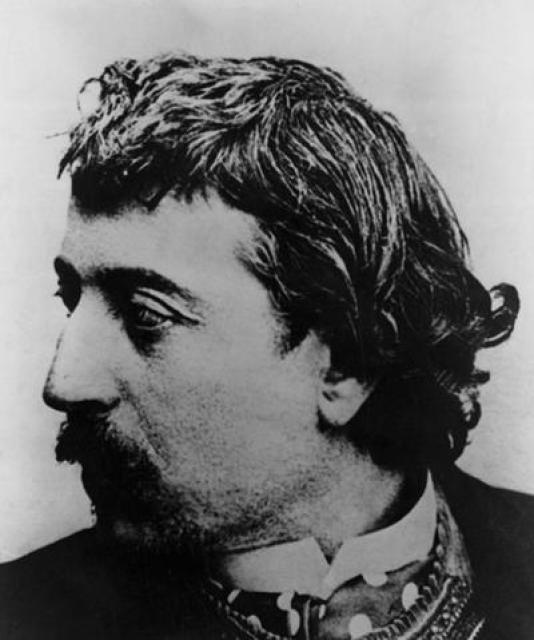
Paul Gauguin was a French painter and one of the leading representatives of Post-Impressionism. He preferred to indulge in dreams and was known for his rebellious spirit. Born in 1848, Gauguin inherited his rebellious nature from his grandmother Flora Tristan, a famous French revolutionary. His grandfather was involved in arts and crafts related to the arts, and he himself was a lithographer. Stories about Peru, where the wealthy Aragonese Tristán Moscoso family, to which Gauguin's great-grandfather belonged, had moved, were passed down from mouth to mouth in the family. Even as a child, Gauguin listened to stories about the Incas, Montezuma, and believed that he was a descendant of this ancient people. His appearance even reflected these stories, as his Inca-like profile distinguished him from Europeans.
In 1848, Paris was filled with barricades, and the shadow of Flora Tristan loomed over them. At just over a year old, Gauguin's parents made the decision to leave their homeland, as it was dangerous to stay. The ship they boarded was headed to South America, specifically Peru, where the family hoped to find a peaceful and prosperous life. However, Gauguin's father died on the journey. But for the young boy, it didn't seem to be a great shock. Life in Peru was vibrant and lively. Gauguin was surrounded by a colorful and noisy environment. He sought refuge from the bright sun in the shade of palm trees, magnolias, and rosewood trees. His childlike gaze would stop at the peculiar animals; llamas stretching their long necks, hawks flying with red feet and bluish necks. The skin color of the locals varied in all imaginable shades, and their physique and facial features were also diverse. All of this was engulfed in luxury, which was the passion of the city. Silk, satin, precious stones - it was all within reach.
But the revolutionary turmoil reached Peru as well. It became unsafe to stay, and Gauguin's family returned to France. Gauguin became withdrawn and grumpy, struggling to adjust to the new conditions. The contrast between the colorful, sun-drenched land and this cold, gray country was striking. Nothing here could interest him! Gauguin did not excel in boarding school. He preferred to indulge in dreams. One of his teachers once said, "This child will either be an idiot or a genius."
The dream of rediscovering his lost paradise, feeling the breath of the tropics, pushed Gauguin to become a sailor. On December 7, 1865, he boarded the ship "Lusitano," which was heading to Rio de Janeiro. Was it a mere coincidence or a sign? Exactly 17 years ago, on the same ship and following the same route, Gauguin's teacher and mentor, Camille Pissarro, embarked as an apprentice. The sound of the ocean pleased Gauguin's ears, and new lands unfolded before him. But gradually, melancholy took hold of his soul again. He quickly became disillusioned with the sailor's profession. Then his guardian, Gustave Arosa, arranged for him to work as a stockbroker. This occupation did not require special knowledge, and Gauguin, a former sailor, took on the new job. Gauguin was fortunate in his first steps on the stock exchange: the stock prices constantly rose, he conducted business carefully, and his employers and clients were satisfied. Gauguin earned a good amount of money, but it seemed not to concern him. Something was missing for complete happiness.
And then he met her - Mette-Sophie Gad. Her thick mass of blonde hair beautifully framed her laughing face, and her voluptuous curves caught the eye. Her confident demeanor and open gaze captivated Gauguin from the moment they met. The only thing that Gauguin failed to notice was the strong, unwavering, almost masculine character of the girl. She did not know how to flirt or create romantic intrigues. It brought her no pleasure. Moreover, her difficult life made her calculating: her father died, and her mother supported Mette and her two sisters and brothers on a small pension. Before she turned 18, she had to work as a governess. An unsuccessful romance with a naval officer cooled Mette's love passion forever.
But Gauguin was so in love with the beautiful girl that he seemed to overlook everything. In the strong, cold, and rational Scandinavian, he saw an "original character." Gauguin believed that she alone would bring him peace and consolation. They soon married, and initially, everything went well. Gauguin made money, and Mette took care of the household. The only thing that didn't fit in her mind was her husband's passion for painting, which he devoted all his free time to. But wise Mette treated it as innocent mischief. And then, out of the blue, Gauguin decided to quit his prestigious job and pursue painting! Supposedly, his friend and teacher, Camille Pissarro, had done the same. Mette was furious! It turns out she didn't know the person she had lived with for ten years at all. The lack of money - if only that were the only thing to endure! Being the wife of a stockbroker and the wife of an artist - these were two different things. Gauguin's action pushed her far down the social ladder. Overnight, her world collapsed. Mette could never forgive her husband for this.
But Gauguin, despite everything, continued to love her and was terribly afraid of losing her. Let it be, let them live separately for a while, as Mette insisted, and when everything was settled for him, she and the children would move back to him. And, in his imagination, this was supposed to happen very soon.
However, Gauguin soon realized that painting would not be able to support him. Without means, he had to change apartments in search of a cheaper one, eat poorly, live on the generosity of casual acquaintances, or find temporary work. Reality appeared before him in its true form - and how different it was from the world that existed in his imagination, and how pitiful people seemed before him! And they dare to call themselves civilized? Away from this civilization! Change places, run away! Gauguin knew no other salvation but escape: somewhere, there must be a land where he would finally be happy among people who understood him! Panama - that was the salvation from shallow, busy France. There, he would finally forget the cold and hunger, and be able to paint as much as he wanted... He repeated these words repeatedly: before the failed trip to Madagascar, before leaving for Tahiti, and then - to the Marquesas Islands.
However, civilization seemed to find Gauguin at the edge of the earth. Gauguin found his final refuge on the Marquesas Islands. But the detested civilization reached there too. In the final years of his life, the artist decided to fight against it. Gauguin engaged in a fierce battle with colonial officials for the right of the natives to live by the laws of their ancestors, for their right to be called humans. Illnesses weakened his strength, but, like his grandmother Flora Tristan, he paid no attention to it. Her spirit lived on in him. Manao tupapau! In this fight, he burned himself out: after another blow, Gauguin did not recover.