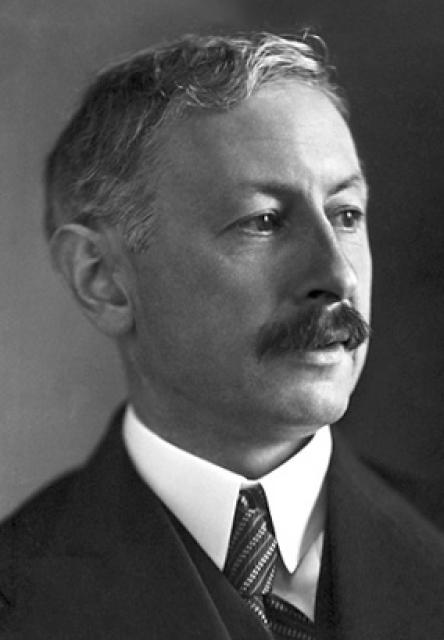
Paul Karrer
 Switzerland
Biography of Paul Karrer
Paul Karrer, a Swiss chemist, was born in Moscow, Russia, where his father, after whom he was named, worked as a dentist. When he was three years old, his family returned to their homeland, Switzerland, and lived in Zurich for some time before settling in the district of Wildberg in the canton of Aargau. Karrer attended elementary school in the nearby town of Moriken, middle school in Lenzburg, and high school in Aarau. He developed a serious interest in science while attending middle school.
In 1908, Karrer enrolled at the University of Zurich, where he studied chemistry under Alfred Werner. In 1911, he obtained his doctoral degree for his dissertation on the complex compounds of cobalt and became Werner's assistant at the Chemical Institute of the university. His first scientific paper on organic compounds of arsenic made a profound impression on Paul Ehrlich, who offered Karrer a position as his assistant at the Chemotherapeutic Research Institute in Frankfurt, Germany, in 1912.
With the outbreak of World War I in 1914, Karrer was forced to return to Switzerland as he was called up to serve as an artillery officer in the Swiss army. However, in 1915, after Ehrlich's death, he returned to Frankfurt to continue his scientific research at the Chemotherapeutic Research Institute. Over the next three years, Karrer studied the chemistry of plant products and later held the position of adjunct professor of organic chemistry at the University of Zurich. In December 1919, Karrer succeeded Werner as a professor of chemistry and director of the Chemical Institute. Here, he conducted research on sugars, amino acids, and proteins. He was particularly interested in the stereochemistry (i.e., spatial arrangement of atoms in molecules) of these and other organic compounds.
In 1927, Karrer turned his attention to the study of anthocyanins, a group of pigments responsible for the red and blue coloring of plant flowers. Richard Willstätter, who worked at the Federal Institute of Technology in Zurich, had already isolated and studied the molecular structure of these compounds. Karrer, however, focused on the composition of anthocyanins. The following year, he began studying crocin, a yellow pigment found in plants like saffron and gardenia, and in 1930, he determined the structure of beta-carotene, which is found in carrots and other plants, an achievement that had been recently established by Richard Kuhn. Karrer discovered that the molecule of beta-carotene consists of two symmetrical parts, each being a mirror image of the other with respect to an imaginary vertical axis.
His research on plant pigments led Karrer to the study of vitamins, a topic of significant interest since the beginning of the 20th century, which was only starting to unravel the mysteries related to the body's nutritional needs. By determining that carotene is converted into vitamin A in the body, Karrer isolated this vitamin from fish liver oil and by 1931, he not only determined its composition but also its molecular structure. He found that vitamin A consists of 20 carbon atoms, 30 hydrogen atoms, and 1 oxygen atom, which together form a six-membered closed ring with three methyl groups attached to each end and a long zigzag chain attached to the third end. Such a configuration represents half of the beta-carotene molecule with an attached water molecule. With this discovery, Karrer became the first scientist to describe the molecular structure of a vitamin.
In the early 1930s, based on his knowledge of organic pigments, Karrer continued his study of vitamins. From over 100 tons of serum, he obtained a tiny amount of a water-soluble nitrogen-containing pigment, named lactoflavin, later known as riboflavin or vitamin B2. Through chemical analysis, Karrer determined its formula and molecular structure and in 1935, synthesized this substance.
In 1937, Karrer was awarded the Nobel Prize in Chemistry "for his investigations on carotenoids, flavins, and vitamins A and B2." He shared this prize with English chemist Walter Norman Haworth. In his Nobel lecture, Karrer emphasized that in just a few years, with the help of new analytical methods, approximately 40 carotenoids had been discovered. He reminded his audience that "barely 10 years have passed since many researchers doubted the material specificity of vitamins and held the opinion that the particular effects observed by vitamins... were due to a special state of matter." In conclusion, Karrer stated, "The chemical aspect of the vitamin problem is essentially solved. The task of physiology... is to explain the intervention of these agents in the processes of cellular activity."
A year after receiving the Nobel Prize, Karrer synthesized vitamin E, followed by the isolation of vitamin K. He then focused on studying nicotinamide adenine dinucleotide (NAD), a coenzyme that regulates hydrogen exchange between molecules inside the cell, thus creating intracellular energy. In 1942, Karrer determined the structure of this substance. Later, in the 1940s, he returned to studying carotenoids and by 1950, completed the synthesis of all these compounds. During the same period, he led research on curare, a natural poison, the derivatives of which have since been used in surgery as muscle relaxants.
From 1950 to 1953, Karrer served as the rector of the University of Zurich. He continued to actively engage in scientific activities even after his retirement in 1959. In 1914, Karrer married Helene Frolich, whose father was the director of a psychiatric clinic in Konigsfelden. The couple had three sons, one of whom died in infancy. An exceptionally meticulous researcher, Karrer was highly regarded for his kindness and humility. Despite his wealth, he did not own a car and commuted to work by bus every day. Karrer passed away in Zurich on June 18, 1971, after a brief illness.
In addition to the Nobel Prize, Karrer received the Marcel Benoist Prize (1923), the Stanislao Cannizzaro Prize of the Italian National Academy of Sciences (1935), and numerous other awards. He was a member of scientific societies across three continents, including the Royal Society of London, the Academy of Sciences in Paris, the national academies of sciences in Italy and the United States, and held honorary degrees from universities in Paris, London, Zurich, Basel, Strasbourg, Breslau, Brussels, Turin, and Madrid.


