Pavel Cherenkov
- Early life and education
- Discovery of the Cherenkov effect
- Research career and Nobel Prize
- Later work and legacy
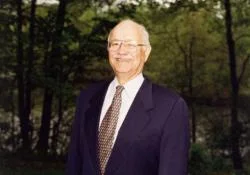
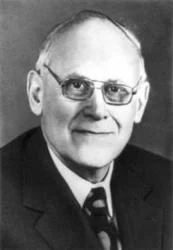
Pavel Cherenkov was a Soviet experimental physicist whose observations revealed a distinctive blue glow produced by fast charged particles moving through a transparent material. The phenomenon became known as Cherenkov radiation and is now used in particle detectors, nuclear reactors, and astrophysics. Cherenkov shared the 1958 Nobel Prize in Physics with Ilya Frank and Igor Tamm, who developed the theoretical explanation of the effect he had first observed.
Early life and education
Cherenkov was born on July 28, 1904, in the village of Novaya Chigla in the Voronezh region of the Russian Empire. He studied at Voronezh State University, graduating in 1928. He moved to Moscow and began research at the Lebedev Physical Institute, where he worked with physicist Sergei Vavilov.
The institute was a leading center for Soviet research in optics and radiation. Cherenkov’s work began with experiments on the effects of gamma rays in liquids. Researchers knew that radiation could cause some materials to fluoresce, but a faint blue light seen in pure liquids did not fit easily into that explanation.
Discovery of the Cherenkov effect
In 1934, Cherenkov reported that gamma rays passing through liquids such as water produced a visible glow. Through careful experiments, he found that the light was emitted not directly by the gamma rays but by fast electrons set in motion when the radiation interacted with matter. He also established that the light had distinctive properties, including its direction and polarization, that separated it from ordinary fluorescence.
Cherenkov and Vavilov published early reports on the phenomenon. Further investigation showed that the light appeared when charged particles traveled through a medium faster than light could travel through that same medium. The effect does not violate the universal speed limit of light in a vacuum: light slows in materials such as water or glass, so a particle can exceed the local speed of light there while remaining below the vacuum speed.
Ilya Frank and Igor Tamm provided the theoretical interpretation in 1937, explaining how the moving charge generated a cone of radiation. The effect is often compared to a sonic boom: just as an aircraft can outrun sound in air, a charged particle can move faster than light propagates through a material and leave a characteristic emission. The light is frequently blue because of the way the radiation’s intensity varies across wavelengths.
Research career and Nobel Prize
Cherenkov continued working at the Lebedev Physical Institute and became a prominent leader in experimental physics. His observations helped establish a new method for detecting high-energy particles. Instruments known as Cherenkov detectors use the emitted light and its cone angle to identify particles and measure their speed. Such detectors became important in nuclear and particle physics and later in neutrino and cosmic-ray experiments.
In 1958, Cherenkov, Frank, and Tamm received the Nobel Prize in Physics “for the discovery and the interpretation of the Cherenkov effect.” The prize recognized both the experimental discovery and the theory that explained it. Cherenkov’s Nobel lecture described the original experiments and how they transformed a faint, puzzling glow into a tool for experimental physics.
The phenomenon also has practical uses beyond fundamental research. The blue light seen in water around a nuclear reactor is a familiar example of Cherenkov radiation. Its detection helps researchers study radioactive materials, monitor reactor conditions, and identify particles produced in high-energy events. In astrophysics, observatories use the effect to study cosmic rays and gamma rays arriving from space.
Later work and legacy
Cherenkov’s scientific career extended beyond the discovery that made him famous. He worked on experimental techniques and helped develop particle accelerators, while continuing to contribute to research at the Lebedev Institute. He remained in the Soviet Union throughout his career and became one of the country’s leading physicists.
He died in Moscow on January 6, 1990. The effect that bears his name remains a central tool in experimental science. Cherenkov’s legacy lies in the precision of his observations: by distinguishing an unfamiliar glow from known forms of luminescence, he uncovered a new physical process and opened a powerful way to see particles that would otherwise remain invisible.