Pavel Dargis
 Lithuania
Biography of Pavel Dargis
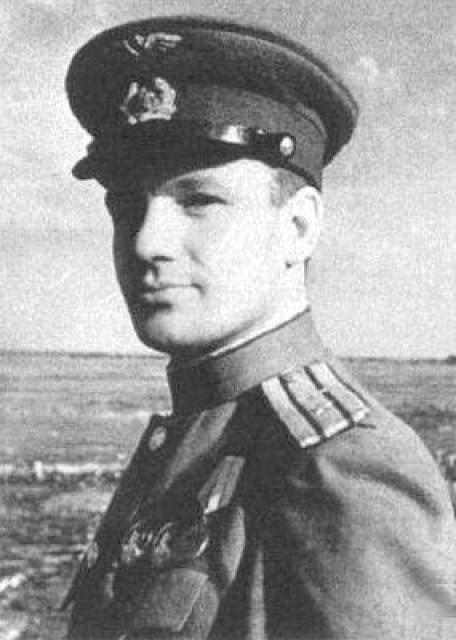
Pavel Nikolaevich Dargis was born on March 17, 1913, in the city of Kaunas, Lithuania. He came from a working-class family and completed his education at a rural school in Shklov, Belarus, and a technical school. Dargis worked as an electrician at the Spartak Paper Mill before joining the Komsomol in 1930.
On July 25, 1932, Dargis enlisted in the Red Army and served as a soldier in Gomel. After a year, he entered the 1st Kachin Military Aviation School named after A.F. Myasnikov. Dargis went on to become a pilot in the 116th and 47th Fighter Aviation Regiments, an instructor pilot in the 163rd Reserve Aviation Regiment, and a pilot in the 7th Fighter Aviation Regiment.
When the Great Patriotic War broke out, Dargis actively participated from the first day. In one of the battles, he shot down a Me-109 but was injured and lost consciousness. His uncontrollable plane started to descend. At that moment, two Me-109 planes attacked him, attempting to finish him off. Enemy fire shattered the glass, and fragments cut his face and chest. Despite the pain, Dargis regained consciousness, took control of the plane, gained altitude, and shot down the second "Messerschmitt." He then returned to the airfield where he was already considered dead.
Combat Achievements
The 7th Fighter Aviation Regiment was a formidable unit, and its pilots successfully fought even against highly experienced German aces. For example, on July 30, 1941, Hauptmann Arnold Lignitz, the commander of the III Group of the famous JG 54 "Grunherz" squadron (with 25 victories), did not return to his airfield. He became a victim of his own curiosity and recklessness.
When Leningrad fell within the radius of Me-109's actions, the pilots of "Grunherz," who had seen many cities in Europe from the air, could not resist the temptation. On that day, Hauptmann Lignitz and his wingman, Lieutenant Erwin Leikauf, took off on their own initiative and headed towards the center of Leningrad, bypassing the front line. As they flew over the Neva River, the leading plane began to turn around, and at that moment, a pair of "MiGs," unseen in the sunlight, attacked the "Messerschmitts" from behind. Lieutenant Leikauf, nicknamed "the snake" for his piloting style, managed to avoid the attack by sliding and, while performing a wing-over, saw the commander's plane being shot down and spiraling down. Lignitz abandoned his damaged aircraft and saved himself with a parachute but landed on a rooftop and then on the pavement. He died two days later at the Naval Hospital. The victory over Lignitz was achieved by the pilots of the 7th Fighter Aviation Regiment, Captain Polyakov and Senior Lieutenant Shamin.
On August 13, 1941, Lieutenant P. N. Dargis, the flight leader of the 7th Fighter Aviation Regiment, distinguished himself. On that day, he flew as part of a squadron of MiG-3s to defend the Moloskovets railway station near Leningrad from enemy aircraft. Upon approaching the station, our pilots spotted two dozen German bombers. They managed to shoot down the leading "Junkers" with their first attack, causing the rest to turn away. However, six "Junkers," after circling, attempted to approach the station again. At that moment, Dargis noticed another four "Junkers" approaching from the opposite direction. There was a considerable gap between the two outermost enemy planes. Dargis pressed the trigger, but his machine gun fell silent after a short burst. He then decided to ram. Dargis aimed his fighter at the gap between the bombers and sliced off the tail of one of them. Losing control, it crashed to the ground. This was Dargis's fifth aerial victory.
Post-War Career
After the battles on the Leningrad, Moscow, and Northern fronts, Dargis continued to serve in the Air Defense Forces. He held positions as the deputy commander of the 428th Fighter Aviation Regiment, navigator of the 565th Fighter Aviation Regiment, and commander of the 28th Fighter Aviation Regiment. Dargis completed a total of 160 successful combat missions, shot down 13 enemy aircraft personally and 6 in group battles (according to other sources: 7 personally and 8 in group battles), and flew on 7 ground attack missions.
For his bravery and achievements, Dargis was awarded the Orders of Lenin (twice), the Order of the Red Banner, the Order of the Red Star, and various medals. After retiring from the military with the rank of Colonel, he lived in the city of Sochi.