Pavel Trubetskoy
 Italy
ItalyBiography of Pavel (Paolo) Trubetskoy
Russian sculptor Pavel Petrovich Trubetskoy was born on November 16, 1866 in Intr, Italy, on Lake Maggiore, in his parents' estate. His father, Prince Peter Sergeevich Trubetskoy, was Russian, and his mother was American. At the age of eight, he became interested in sculpture and, under the influence of his brother Pietro, a decorator, he created his first sculptures for a puppet theater. Two years later, he began taking lessons from the painter D. Ranzoni. He started serious sculpting in Milan in 1884 in the studio of Barkaly and later with E. Bazzaro. Although Trubetskoy did not receive formal artistic education, his rare talent and determination contributed to his success.
In 1886, the young sculptor presented his work, a statue of a horse, for the first time at an exhibition in Brescia, Italy, and then his works appeared at exhibitions in France and America. He created portraits, engaged in animal sculpture, and experimented with monumental sculpture. In 1891, he participated in competitions for monuments to Garibaldi and Dante. In 1897, Trubetskoy traveled to Russia, his father's homeland. Captivated by new impressions, the sculptor worked intensively and soon began teaching at the Moscow School of Painting, Sculpture, and Architecture. The bronze sculpture "Moscow Cab Driver" (1898, GRM) was his first work executed in Russia. The genre composition seemed traditional in terms of the subject matter. Similar domestic scenes were common in the works of Russian sculptors such as E. A. Lansere and L. V. Pozin. However, for Trubetskoy, it was an embodiment of his first Russian impressions, without contemplative ethnography, with captivating sincerity and a special plastic expressiveness of soft, "flowing" forms. His works exhibited at exhibitions stirred sharp criticism from conservative circles of the St. Petersburg Academy, who saw his innovative method as a violation of "classical" canons, but also attracted the attention of progressive representatives of Russian society and the artistic intelligentsia. The sculptor met and became close with I. E. Repin, I. I. Levitan, V. A. Serov, and F. I. Shalyapin. He had a great friendship with Leo Tolstoy, who held him in high regard. According to Tolstoy's secretary V. A. Bulgakov, "the sculptor Paolo Trubetskoy... was one of Leo Nikolayevich's favorites... He loved him for his simple open soul, sincerity, hatred of social conventions, love for animals, and vegetarianism." Lev Nikolayevich willingly posed for him and had conversations with him in the sculptor's studio and at his estate in Yasnaya Polyana.
The bust of Leo Tolstoy (1899, GRM) and the statuette "Leo Tolstoy on Horseback" (1900, GRM) gained worldwide fame. The sculptor portrayed the calmness and wisdom, intolerance of hypocrisy, and simplicity and magnanimity of the brilliant Russian writer. In 1900, Trubetskoy's works were exhibited in the Russian section at the World Exhibition in Paris. Alongside Auguste Rodin, he was awarded the highest prize for his portraits of Leo Tolstoy, L. Golitsyn, and the group "Moscow Cab Driver."
This was followed by a series of portrait statuettes characterized by spiritual depth and unique individuality of characterization: the artistically elegant and internally excited I. I. Levitan (1899, GRM), the inspired F. I. Shalyapin (1899-1900, GRM), and the joyful and good-natured S. S. Botkin (1906, GRM). Trubetskoy's sculptural works are distinguished by vivid artistic techniques: pictorial mobility and at the same time clarity of plastic forms, striving to avoid flat and smooth - inert - surfaces. In this mobility, in the seemingly deep movement of the forms, the sculptor reveals the hidden emotional facets of the models. Observational keenness, poeticism, and the softness of the sculpting are especially characteristic of his female portraits. The striking M. K. Tenisheva in a ball gown (1899, GRM), the aristocratic Golitsyna (1911, State Art Museum of the BSSR), "Mother with a Child" (1898, GRM, GTG), "Mother with a Son" (1901, GRM), and the charming model Dunya (1900, GRM) - all of these works stand out for their originality of compositional solutions and artistic techniques.
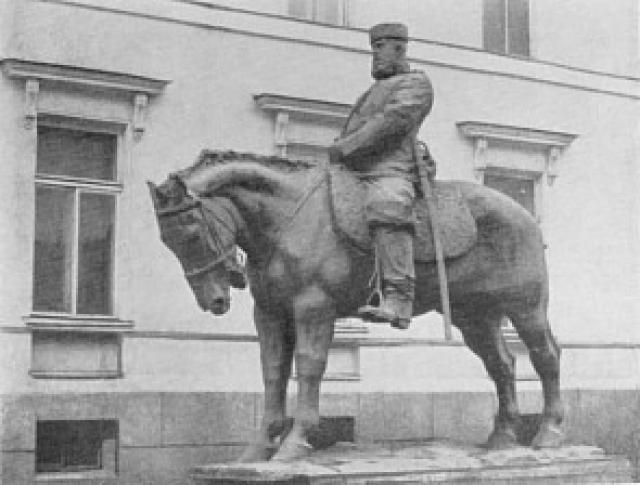
Children's images are enveloped in a special lyricism: "Children. Nikolay and Vladimir Trubetskoy" (1900, GRM), "Girl with a Dog (Friends)" (1901, GRM). The sculptor's animalistic works are marked by a peculiar psychological insight. Works such as "Dog" (1899, GTG), "Horse with Foal" (1899, Smolensk Regional Local Lore Museum), "Siberian Husky" (1903, GRM), and "Horse Under Saddle" (1898, GRM) are distinguished by their depth of emotion. From 1899 to 1909, the sculptor worked on the monumental monument to Alexander III. For this, a special glass and iron workshop pavilion was built on Stary Nevsky Prospect, not far from the Alexander Nevsky Lavra. In the preparatory stage, Trubetskoy created eight small models, four in life-size and two in the scale of the monument itself.
After winning the competition in 1900 to create the monument to Alexander III, Trubetskoy paid little attention to the remarks of the monument construction commission. Sergei Witte lamented in his memoirs about the sculptor's "uncompromising character." Trubetskoy apparently disregarded the opinions of Grand Duke Vladimir Alexandrovich, who saw the "Trubetskoy model as a caricature of his brother." However, the widowed empress, satisfied with the clearly expressed resemblance, contributed to the completion of the work on the monument. The monument to Alexander III was significantly different from many other official imperial monuments; the sculptor was far from idealization and the desire for grandeur.
Before the monument's unveiling, the sculptor felt the disapproval of many members of the imperial family and senior officials. Nicholas II wanted to move the monument to Irkutsk and "send it into exile in Siberia, far from the offended eyes of his sons," and erect a different monument in the capital. Sergei Witte recalls that the sculptor did not even receive a timely invitation to the monument's grand opening and arrived in St. Petersburg later.
Falling out of favor with the authorities and lacking opportunities to work on a new major commission, Trubetskoy left the country. From 1906 to 1914, while in Paris, he created sculptural portraits of A. Rodin, A. France, G. Puccini, S. A. Muromtsev, and in London, he made a portrait of G. B. Shaw. However, Trubetskoy continued to participate in competitions and art exhibitions held in Russia. In 1912, he had solo exhibitions in America (Chicago) and Italy (Rome).
In 1914, Trubetskoy went to America, where he created monuments to Dante (San Francisco) and General Otis (Los Angeles). In 1921, he returned to Paris, and spent his last years in Italy. He sculpted a marble statue of the famous Caruso for La Scala theater in Milan and created a monument to fallen soldiers in the city of Brescia. He also sculpted the portrait of Gabriel D'Annunzio, an autographed self-portrait for the Uffizi Gallery in Florence, and the portrait of one of Italy's most famous artists, D. Segantini.
Trubetskoy exhibited his works in Egypt (1934) and Spain (1935). He died in Italy on February 12, 1938. Although he lived a short time in Russia, Pavel Petrovich Trubetskoy made significant contributions to Russian art, greatly expanding the boundaries of sculptural exploration. The depth of his understanding of the image, the temperament of form, and the uniqueness of his style had a tremendous influence on the development of Russian sculpture. Materials from T. Volodina's article in the book: 1984. One Hundred Memorial Dates. Artistic Calendar. Annual illustrated edition. Moscow, 1984.