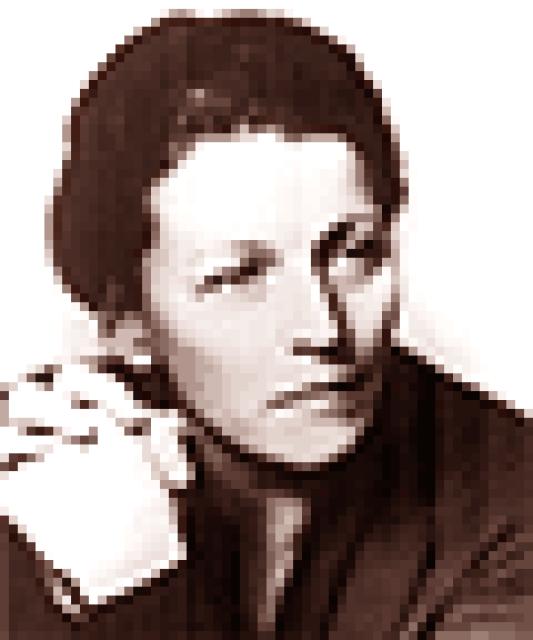
Pearl Buck
 USA
USABiography of Pearl Buck
Pearl Comfort (Sydenstricker) Buck was an American writer and Nobel laureate in 1938. She was born on June 26, 1892, in Hillsboro, West Virginia, to Presbyterian missionaries in China. Buck was the only one of her six siblings to be born in the United States. Her father, Absalom Sydenstricker, was a stern, introverted man who dedicated many years to translating the Bible from Greek to Chinese. Her mother, Caroline Stulting, was a highly educated and cultured woman who had a passion for literature and had traveled extensively in her youth.
When Pearl was still a child, her parents returned to China and settled in the city of Jinzhai, preferring to live among the Chinese rather than in areas predominantly occupied by foreigners. As a result, Pearl learned to speak Chinese before she learned English. She was so well accepted by her Chinese peers that she did not feel like a foreigner in China until the age of nine. During the Boxer Rebellion, when the Empress ordered the execution of all foreigners, the Sydenstrickers fled to Shanghai, but returned to Jinzhai after the rebellion was suppressed.
Pearl's early education was provided by her mother and a Chinese tutor who was a Confucian scholar. At the age of 15, she was sent to a boarding school in Shanghai. In 1910, she returned to the United States and enrolled at Randolph-Macon Woman's College in Virginia, where she studied psychology and received two literary awards. After graduating in 1914, she returned to China to work as a teacher in the Presbyterian mission. Three years later, she married John Lossing Buck, an agricultural specialist and missionary in China. The young couple settled in a northern village, where Pearl continued teaching and also served as a translator for her husband during his travels in rural areas. In 1921, their daughter Carol was born, but shortly after, Pearl's mother passed away. Pearl decided to write her mother's biography, which was published much later.
By this time, the Buck family had moved to Nanjing, where John taught agricultural sciences at the local university and Pearl taught English and American literature. Pearl started writing at a young age, and her early literary attempts appeared in the children's supplement of the English-language newspaper "Shanghai Mercury." After completing her mother's biography, which was published years later, Pearl began working on a novel. In the early 1920s, her articles about China were published in "The Atlantic Monthly" and other American magazines. Pearl and John returned to the United States for a year to pursue graduate studies at Cornell University, where Pearl earned a master's degree in literature. During this time, they also discovered that their daughter was mentally disabled and decided to adopt another girl, Janice.
When the Bucks returned to China in 1927, the country was in the midst of a civil war. Their home in Nanjing had been looted, and the manuscript of Pearl's first novel was lost. In the same year, the family was evacuated to Shanghai and later to Japan. It was during this time that Pearl completed her second novel, "East Wind: West Wind," which she had started writing on the ship from the United States to China. The novel was published in 1930 and became a bestseller. In 1931, she published her most famous work, "The Good Earth," for which she was awarded the Pulitzer Prize. The book tells the story of a poor peasant family's struggle for prosperity and the creation of a family dynasty. It was praised for its simple style, reminiscent of biblical literature, and was considered a parable about human life.
In the following years, Pearl published two sequels to "The Good Earth," titled "Sons" (1932) and "A House Divided" (1935). All three novels were published together in 1935 under the title "The House of Earth." During these early years of her literary career, Pearl wrote extensively, including the novel "Mother" (1934), biographies of her mother ("The Exile," 1936) and father ("Fighting Angel," 1936), "The Proud Heart," her first book set in America, a translation of the two-volume classic Chinese novel "Shuihu Zhuan," published in 1933 and titled "All Men Are Brothers."
In 1938, Pearl became the first American woman to receive the Nobel Prize in Literature "for her rich and truly epic descriptions of Chinese peasant life and for biographical masterpieces." In her acceptance speech, she expressed gratitude to the Chinese people, whose lives had been closely intertwined with her own for many years. The award sparked a lively debate among critics, with some claiming that Buck's work, while talented and interesting, was not grand enough for such a prestigious prize. However, her books continued to enjoy immense popularity, although her reputation gradually declined after receiving the Nobel Prize, with critics pointing out didacticism and sentimentality in her works.
In 1935, Buck divorced her first husband and married her publisher, Richard Walsh. The couple became active members of the East-West Association, which fostered cultural exchanges, and the philanthropic organization "Welcome House," which provided support for those interested in adopting Asian-American children. Pearl contributed her savings to the Pearl S. Buck Foundation, which funded various charitable and educational initiatives.
Pearl Buck passed away at the age of 80 in Danby, Vermont, nearly 13 years after her second husband Richard Walsh. In addition to the Nobel Prize, she received the William Dean Howells Medal from the American Academy of Arts and Sciences in 1935, as well as numerous humanitarian awards, honorary degrees from Yale University, West Virginia University, Howard University, Philadelphia College of Medicine for Women, and other institutions of higher education. In 1951, she was elected a member of the American Academy of Arts and Sciences.