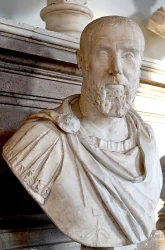
Pescennius Niger
Pescennius Niger was a Roman governor and military commander who claimed the imperial throne in 193, during the upheaval known as the Year of the Five Emperors. Proclaimed by troops in Syria, he won support across much of the eastern provinces and challenged Septimius Severus for control of the empire. Severus defeated his forces in a series of battles, culminating near Issus in 194. Niger was captured and killed while trying to escape.
A provincial commander
Gaius Pescennius Niger had advanced through Roman public and military service before becoming governor of Syria around 191. The surviving accounts say relatively little about his early life, and details of his birth and family are uncertain. His command gave him access to several eastern legions and to a strategic region stretching from Syria toward Egypt and Asia Minor.
In 193, Emperor Pertinax was assassinated after a short reign. The Praetorian Guard then backed Didius Julianus, while provincial armies raised other candidates. Soldiers in Pannonia proclaimed Septimius Severus, and the eastern troops declared for Niger. The empire was again divided by competing military claims.
Claim to the throne
Niger was proclaimed emperor in Syria in 193. He appears to have had broad support in the eastern provinces, including in major cities and among several legions. His position gave him the resources to challenge Severus, who had secured Rome and the support of the Danubian armies.
Severus moved quickly to isolate his rival. His forces advanced through the Balkans and Asia Minor, while cities and regional leaders shifted their allegiance as the campaign developed. Niger’s armies suffered defeats at Cyzicus and Nicaea, weakening his hold on the region. Egypt and other eastern territories later recognized Severus.
Defeat near Issus
The decisive confrontation took place near Issus, in southeastern Asia Minor, in 194. Niger’s forces were defeated, and he retreated toward Antioch. He was captured and killed while attempting to flee, according to the main narrative sources. The precise details of his final moments are not entirely clear.
Severus secured control of the empire, though he soon faced another rival, Clodius Albinus, in the West. The conflicts of 193–197 established Severus’ dynasty and reshaped the relationship between imperial power and the provincial armies.
Historical legacy
Niger’s brief claim to power illustrates the central role of the legions in imperial succession. A governor with strong regional support could challenge a ruler in Rome, but victory depended on securing the larger military balance across the empire.
Most surviving accounts were written after Severus’ victory, so Niger’s reputation comes largely through sources shaped by the victor’s regime. His prominence as a rival emperor is nevertheless clear from the sequence of campaigns and the territories that initially supported him.