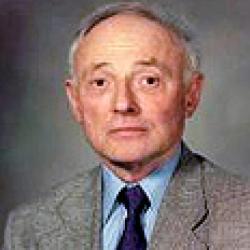
Peter Lax
 Hungary
Biography of Peter Lax
Peter Lax, a Hungarian-American mathematician, was born in 1926 in Budapest to a Jewish family. Both of his parents, Henry Lax and Clara Kornfeld, were physicians. In 1941, the entire family moved to New York as permanent residents. At the age of 19, Lax participated in the Manhattan Project, a program focused on developing nuclear weapons.
Education and Career
In 1949, Lax obtained a Ph.D. degree in Philosophy from New York University. He then went on to work as a researcher at the Los Alamos National Laboratory and the Courant Institute of Mathematical Sciences. Lax's field of expertise was diverse, including the study of integrable systems, shock waves, and hydrodynamics. He also made significant contributions to the development of soliton theory.
Achievements
Lax's name is associated with numerous mathematical achievements and numerical methods, such as the Lax-Milgram lemma, Lax's equivalence theorem, Lax-Friedrichs scheme, Lax-Wendroff scheme, Lax's entropy condition, and the Lax-Levermore theory. His exceptional work has been recognized through numerous awards and honors. Lax has been a member of the National Academy of Sciences since 1970. In 1975, he received the Norbert Wiener Prize, followed by the National Medal of Science in 1986 and the Wolf Prize in 1987. In 2005, Lax was awarded the Abel Prize. He is also an honorary doctor of several universities worldwide, including St. Petersburg State University since 1990.