Peter Poreku Dery
 Ghana
- Childhood and Education
- Priesthood and the Diocese of Wa
- A Church Rooted in Local Culture
- Archbishop and Cardinal
- Death and Legacy
Peter Poreku Dery rose from a rural community in northern Ghana to become one of the most prominent Catholic leaders in the country’s history. As a priest, bishop and cardinal, he combined church leadership with a practical drive to expand education, health care and community development. He also helped shape a more distinctly African expression of Catholic worship.
Childhood and Education
Dery was born on May 10, 1918, in Zemuopare, near Ko and Nandom in what is now Ghana’s Upper West Region. He grew up in a Dagaaba community where formal schooling was not initially part of his life. As a young man, he encountered Catholic missionaries and began training as a catechist. He was baptized on Christmas Eve in 1932, taking the name Peter.
His ability with language and studies soon drew attention. He continued his education at St. Paul’s Junior School in Navrongo, then at the Immaculate Conception Junior Seminary. Alongside further studies, he trained as a teacher before entering priestly formation. His route to the altar was an unusual one for a boy who had started out without Western schooling, but it prepared him for a career that would place education at the center of his ministry.
Priesthood and the Diocese of Wa
After studying at seminaries in southern and northern Ghana, Dery was ordained on February 11, 1951. He served in Nandom and took on parish and diocesan responsibilities, including work in Catholic schools and as vicar general. In 1959, the new Diocese of Wa was created from territory previously administered by Tamale. The following year, Dery was appointed its first bishop and consecrated on May 8, 1960. He was the first indigenous priest from the Upper West Region to be ordained.
As bishop, he worked to build the institutions that could support both religious life and wider community development. The Vatican credits him with founding numerous schools and a minor seminary. The Cardinal Dery Foundation also recalls his support for health services, credit unions, farmers’ cooperatives and rural water projects. His focus was not confined to church structures: he sought to improve daily life in communities where basic services were scarce.
A Church Rooted in Local Culture
Dery was an early advocate of liturgical inculturation, the effort to express Catholic worship through local languages, music and cultural forms. He composed a Dagaare Mass, bringing the language of his people into the liturgy at a time when this approach was still gaining acceptance. He also encouraged lay participation and priestly vocations. His work anticipated broader efforts across the Catholic Church to make worship resonate with African communities while remaining part of a universal tradition.
Archbishop and Cardinal
In 1972, Dery became apostolic administrator of the Tamale Diocese while continuing to serve Wa. He was appointed Bishop of Tamale in 1974. When Tamale was elevated to an archdiocese in 1977, he became its first archbishop. He also served as president of the Ghana Catholic Bishops’ Conference, coordinated the pan-African Council of the Laity and was a member of the Vatican’s Pontifical Council for the Laity.
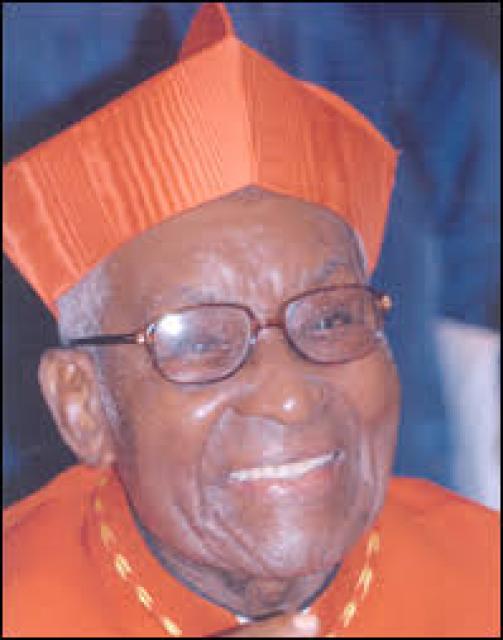
Dery retired as Archbishop of Tamale in 1994. In March 2006, Pope Benedict XVI created him a cardinal, naming him to the College of Cardinals at the age of 87. His cardinalate brought international recognition to a career built largely through decades of pastoral work in northern Ghana.
Death and Legacy
Dery died in Tamale on March 6, 2008. His legacy is associated with the institutions he helped establish, his commitment to local culture in Catholic worship and his sustained attention to rural development. He was widely remembered as a warm and approachable figure who could recall people by name, and as a pastor whose public work reached beyond the church community.
The Catholic Church in Ghana opened a cause for his beatification in 2015, and he received the title Servant of God, the first formal stage in the process toward sainthood. As of 2026, the cause continues; he has not been beatified or canonized. His name remains closely linked with the growth of Catholic life and social institutions in northern Ghana.


