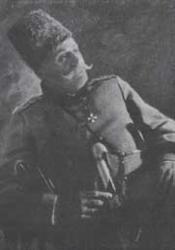
Peter Vrangel
 Russia
Early Life and Military Career
Petr Nikolaevich Wrangel (1878-1928) was a lieutenant general of the Imperial Russian Army and a prominent leader of the White Army movement during the Russian Civil War. He graduated from the Rostov Real School and the Catherine II Mining Institute in Saint Petersburg. Wrangel entered military service on September 1, 1891, as a private in the Life Guard Horse Regiment.
In 1902, he passed the examination for a guards cornet at the Nikolaev Cavalry School and was promoted to cornet on October 12. During the Russo-Japanese War, he volunteered for the 2nd Verkhneudinsk Regiment of the Zabaikalsky Cossack Host. In December 1904, he was promoted to sotnik for "distinction in action against the Japanese" and awarded the Order of St. Anna, 4th degree, with the inscription "For Bravery," and the Order of St. Stanislaus with swords and bow.
On January 6, 1906, Wrangel was transferred to the 55th Dragoon Finland Regiment and promoted to staff captain. On March 26, 1907, he was transferred to the Life Guard Horse Regiment as a lieutenant. In 1910, he graduated from the Nikolaev Academy of the General Staff but remained with his regiment by "personal request."
World War I
In 1913, Wrangel became a captain and squadron commander. He received the Order of St. George for capturing a German battery in a cavalry charge, according to the order of the 1st Army on August 30, 1914. In September 1914, he was appointed assistant regiment commander and awarded the St. George's Weapon. On December 12, 1914, he was promoted to colonel.
From October 1915, Wrangel was appointed commander of the 1st Nerchinsk Regiment of the Zabaikalsky Cossack Host, and on December 16, 1916, commander of the 2nd brigade of the Ussuri Cavalry Division. On January 13, 1917, he was promoted to major general "for combat distinction" and temporarily assumed command of the Ussuri Cavalry Division.
On July 9, 1917, Wrangel was appointed commander of the 7th Cavalry Division, and the following day, July 10, commander of the Combined Cavalry Corps. For covering the infantry's retreat to the Zbrunch River line during the German Tarnopol offensive in July 1917, the officers of the Combined Corps, by resolution, awarded him the 4th degree Soldier's Cross of St. George.
On September 9, 1917, he was appointed commander of the 3rd Cavalry Corps, but he did not assume command.
Russian Civil War
Wrangel joined the Volunteer Army on August 25, 1918. On August 28, he was appointed brigade commander in the 1st Cavalry Division, on August 31, acting commander, and on October 31, chief. On November 15, 1918, he was appointed commander of the 1st Cavalry Corps and on November 22 of the same year, he was promoted to lieutenant general "for combat distinctions."
On December 26, 1918, General Denikin and Don Ataman General Krasnov met at Torgovaya station, where it was deemed necessary to introduce a unified command and subordinate the Don Army to General Denikin. As a result of this decision, on December 26, 1918 (January 8, 1919), General Denikin became Commander-in-Chief of the Armed Forces of South Russia (VSUR). Thus, the position of Commander of the Volunteer Army became vacant. On December 27, 1918, General Wrangel was appointed Commander of the Volunteer Army.
On January 10, 1919, with the division of the Volunteer Army into the Crimean-Azov under General Borovsky and the Caucasian, General Wrangel was appointed commander of the Caucasian Volunteer Army. On the same day, January 10, 1919, General Wrangel issued an order to the Caucasian Volunteer Army, in which he praised the valor of the 1st Cavalry Corps and other troops, thanks to which the Kuban and Stavropol provinces were liberated, and set the task of liberating the Terek.
At the end of January 1919, General Wrangel fell ill with typhus in a severe form. At this time, the acting commander of the army, the chief of his staff, General Yuzefovich, on the orders of the Commander-in-Chief of the VSUR, carried out the transfer of the main forces of the Caucasian Volunteer Army to the Donbass.
At the end of March, having recovered from illness, General Wrangel arrived in Yekaterinodar and discovered that the main Volunteer regiments had been merged into the corps of General Mai-Mayevsky and were engaged in heavy fighting in the coal basin. In light of this, on April 4, 1919, he submitted a secret report to General Denikin proposing to consider "Tsaritsyn as our main and only operational direction, which makes it possible to establish a direct connection with Admiral Kolchak's army."
General Denikin did not agree with General Wrangel's proposal because he considered the shortest line to Moscow via Kharkov, Orel, and Tula to be the main direction for the offensive. It was from this point on that the serious disagreements between General Wrangel and General Denikin began, which later developed into a bitter conflict.
On April 24, 1919, in a letter from the Chief of Staff of the VSUR, General Romanovsky, General Wrangel was asked to accept command of the new Kuban Army, to rename the Caucasian Volunteer Army simply as the Volunteer Army, and to appoint General Mai-Mayevsky as commander. Initially, General Wrangel refused this offer, but when the 10th Red Army's offensive from Velikoknyazheskaya to Torgovaya began, threatening the rear of the Volunteer Army, General Wrangel agreed to the persistent request of Generals Denikin and Romanovsky to take command of a group of troops composed mainly of cavalry corps, to repel the offensive of the 10th Red Army under the command of Egorov.
On May 2, 1920, a fierce battle began at Velikoknyazheskaya, during which General Wrangel personally led his troops in an attack, inflicted a decisive defeat on the 10th Red Army, and forced it to hastily retreat to Tsaritsyn. After the battle at Velikoknyazheskaya, General Wrangel remained commander of the Caucasian Army, which now consisted mainly of Kuban units.
On May 8, 1920, Commander-in-Chief of the VSUR General Denikin ordered General Wrangel to seize Tsaritsyn. On June 18, General Wrangel captured Tsaritsyn, and on June 20, Commander-in-Chief General Denikin arrived in Tsaritsyn, where he immediately issued an order with his famous "Moscow Directive."
According to this directive, General Wrangel was instructed to reach the Saratov-Balashov front and then advance on Moscow through Nizhny Novgorod and Vladimir. At the same time, General Mai-Mayevsky was ordered to advance on Moscow in the direction of Kursk-Orel-Tula.
General Wrangel considered the "Moscow Directive" "a death sentence for the armies of Southern Russia." It lacked maneuverability and allowed for the dispersal of forces. At this time (i.e., at the end of June 1919, when Admiral Kolchak's armies were retreating), General Wrangel suggested to General Denikin that he "concentrate a large cavalry force of 3-4 corps in the Kharkov region" and use this cavalry force in the shortest direction to Moscow together with General Kutepov's Volunteer Corps. However, all these proposals were ignored, and only when the complete incompetence of General Mai-Mayevsky and the catastrophic situation at the front of the Volunteer Army became apparent, General Wrangel was appointed commander of the Volunteer Army and commander-in-chief of the Kharkov region on November 26, 1919.
Due to the deep penetration of Budyonny's cavalry and the lack of sufficient combat-ready cavalry in the Volunteer Army, General Wrangel, in a report dated December 11, 1919, proposed withdrawing the right group of the army to the line of the Mius River-Novocherkassk, and the left to the Crimea. General Denikin did not agree with this, as he believed that the Volunteer Army should not be separated from the Don Army under any circumstances.
On the same day, December 11, a meeting took place in Rostov between the Commander-in-Chief of the VSUR, the commander of the Don Army, General Sidorin, and the commander of the Volunteer Army, General Wrangel. At this meeting, the Commander-in-Chief announced his decision to merge the Volunteer Army into a separate Volunteer Corps and to subordinate it operationally to the commander of the Don Army, General Sidorin. General Wrangel was entrusted with the formation of new Cossack corps in the Kuban and Terek.