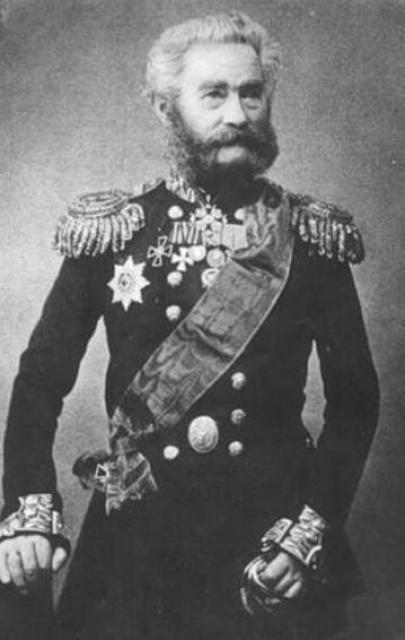
Petr Anju
 Russia
- Early Life and Education
- Arctic Explorations
- 1821: Discovery of New Landmasses
- 1821: Search for Sannikov Land
- 1821: Discovery of a Mirage
- 1821: Further Exploration of New Siberian Islands
- Second Siberian Expedition
- 1823: Discovery of Figurin Island
- 1823: Unsuccessful Search for Sannikov Land
- Later Career and Legacy
- 1827: Naval Service
- Publications and Legacy
Early Life and Education
Pyotr Fyodorovich Anzhu was born in Vyshny Volochyok, Russia, into a doctor's family. He was enrolled in the Naval Cadet Corps, where he excelled academically, ranking second only to Ferdinand von Wrangel.
Arctic Explorations
1821-23: Siberian Coastal ExplorationsIn 1821, Anzhu and Wrangel led the Kolyma and Yana Expeditions, respectively, to explore the northern Siberian coast. Anzhu's Yana Expedition was tasked with surveying the New Siberian Islands and searching for potential landmasses north of the Yana and Kolyma rivers.
1821: Discovery of New Landmasses
In March 1821, Anzhu's expedition reached Stolbovoy Island, where they discovered wooden crosses erected by early Cossack explorers. Continuing northward, they divided into two parties, with Anzhu leading the exploration of Kotelny Island.
1821: Search for Sannikov Land
In April 1821, Anzhu embarked on a search for the legendary Sannikov Land, believed to lie northwest of Kotelny Island. After overcoming obstacles such as ice floes and windstorms, they sighted a mysterious island formation that initially appeared to confirm Sannikov's account.
1821: Discovery of a Mirage
As the expedition approached, it became clear that the mirage was an illusion formed by icebergs. Anzhu and his team returned to Kotelny Island, where they met with Ilya Berezhnykh's party, which had successfully surveyed parts of Faddeyevsky and Kotelny Islands.
1821: Further Exploration of New Siberian Islands
Continuing northward, Anzhu attempted to reach New Siberia Island but encountered open water off the coast. He then proceeded to the northeast, exploring the eastern coastline of New Siberia Island and searching for Sannikov Land but without success.
Second Siberian Expedition
1822: Overland ExpeditionIn 1822, Anzhu led another expedition, with the primary objective of conducting a land survey of the coast between the Yana and Olenyok rivers. The group also planned to explore the New Siberian Islands and search for undiscovered landmasses further north.
1823: Discovery of Figurin Island
In February 1823, Anzhu's expedition discovered a small island lying on a course toward the New Siberian Islands. The island, named after naturalist Alexei Figurin, was approximately four versts in length.
1823: Unsuccessful Search for Sannikov Land
After completing surveys on New Siberia Island, Anzhu unsuccessfully searched for the elusive Sannikov Land to the northeast. Together with Wrangel, he returned to Nizhnekolymsk, marking the end of the expedition.
Later Career and Legacy
1825-26: Aral Sea ExpeditionAfter the Siberian expeditions, Anzhu joined Colonel F.F. Berg's team tasked with surveying the Kazakh steppe. Despite the harsh winter conditions, the expedition successfully mapped the coasts of the Aral Sea.
1827: Naval Service
Anzhu later served on the ship "Gangut" and participated in the Battle of Navarino against the Turks in 1827, where he was wounded but remained at his post.
Publications and Legacy
Anzhu published accounts of his travels and observations during the Siberian expeditions. However, his original manuscripts were destroyed in a fire. He passed away as an admiral in 1849.
Renowned scientists such as Alexander von Humboldt praised Anzhu and Wrangel's work for its contributions to the understanding of geomagnetism, climate, the polar regions, and Arctic flora and fauna. Their expeditions significantly shaped the knowledge of the northern territories and expanded the boundaries of geographical exploration.


