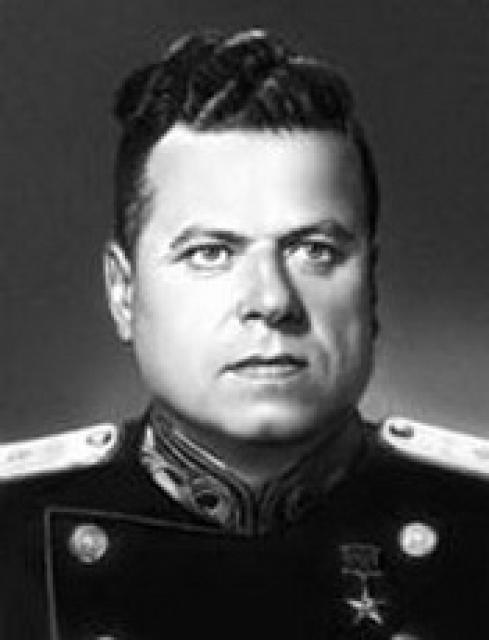
Petr Krivonos
Early Life and Education
Pyotr Fedorovich Krivonos was born on 12th July 1910 in Feodosiya, Russian Empire, to a railway worker. In 1913, his family relocated to Slavyansk. After completing seven years of schooling, he apprenticed as a mechanic in a locomotive depot. From 1926 to 1929, he attended a vocational school in Slavyansk.
Railway Career
In 1929, Krivonos began working as a steam locomotive driver in the Slavyansk depot of the Donetsk Railway. He joined the Communist Party in the same year. In 1935, he initiated a movement on railway transport by increasing boiler pressure, which resulted in a doubling of technical speed to 46-47 km/h. His followers became known as the "Krivonosovtsy."
Krivonos graduated from the Moscow Electromechanical Institute of Railway Transport named after F.E. Dzerzhinsky in 1953. He served as the head of the South-Western Railway from 1953 onwards, although he had been mentioned as the head of the North Donetsk Railway in 1941.
Contributions
Krivonos played a pivotal role in the opening of the Kyiv Children's Railway in 1953. He also had an IS locomotive placed on a pedestal at the city's central railway station, which remains the only surviving complete representative of the series.
Krivonos attended the 18th Congress of the VKP(b) and the 22nd Congress of the CPSU. He was a member of the Central Revision Commission of the VKP(b) from 1939 to 1952. He served as a deputy in the USSR Supreme Soviet from 1937 to 1962 and was elected to the Central Committee of the Communist Party of Ukraine on multiple occasions.
Later Life and Legacy
Krivonos lived in Kyiv until his passing on October 19, 1980. He was laid to rest at the Baikove Cemetery in Kyiv.
Krivonos received numerous awards, including four Orders of Lenin, the Order of the Red Banner of Labor, and the Order of Suvorov, 2nd Class. He was also honored as a Citizen of Honor of Slavyansk in 1971. A postage stamp issued by the USSR in 1986 depicts the locomotive he operated in Slavyansk as part of its "Steam Locomotive Monuments" series.