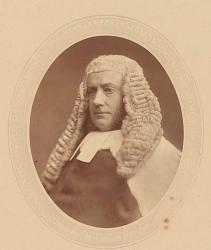
Philippe Sands
 Great Britain
- Philip Sands: International Lawyer and Advocate
- Academic Career
- Legal Career
- International trade disputes
- Claims under the United Nations Convention on the Law of the Sea
- Procceedings involving violations of international criminal law
- Publications and Influence
- UK House of Commons Foreign Affairs Select Committee (June 1, 2004)
- Personal Life
Philip Sands: International Lawyer and Advocate
Early Life and EducationPhilip Sands was born on October 17, 1960, in London, England, into a Jewish family with roots in Lviv, Ukraine. He attended University College School in Hampstead, London, and studied law at Corpus Christi College, Cambridge, earning an undergraduate degree in 1982 and a first-class honors degree in LLM the following year. After completing his postgraduate studies at Cambridge, Sands spent a year as a Visiting Fellow at Harvard Law School.
Academic Career
From 1984 to 1988, Sands was a Fellow of St. Catharine's College, Cambridge, and the Cambridge University Centre for International Law (now the Lauterpacht Centre for International Law). He also held academic appointments at King's College London (1988-1993) and SOAS (1993-2001). He was a Global Professor of Law at New York University School of Law (1993-2003) and has held visiting positions at Paris I (Sorbonne), University of Melbourne, Graduate Institute of International and Development Studies, Indiana University Bloomington, University of Toronto, Boston College Law School, and Lviv University. In 2019, he was appointed the Samuel and Judith Pisar Visiting Professor of Law at Harvard Law School.
Legal Career
Sands was called to the Bar of England and Wales in 1985. In 2000, he co-founded Matrix Chambers, and in 2003 he was appointed Queen's Counsel. Sands was elected a Bencher of the Middle Temple in 2009.
Sands has acted as counsel and advocate in cases covering a broad range of subject areas, including:
Maritime boundary disputes (in the Caribbean, Atlantic, and Pacific Oceans)
Claims relating to natural resources, pollution, and environmental assessment
International trade disputes
Issues concerning the immunity of sitting and former heads of state from the jurisdiction of national and international courts
Claims under the United Nations Convention on the Law of the Sea
Allegations of use of force, torture, genocide, self-determination, and other human rights violations
Procceedings involving violations of international criminal law
Sands has acted as counsel in more than two dozen cases before the International Court of Justice, including the Nuclear Weapons Advisory Opinion (counsel for Solomon Islands); Georgia v. Russia (counsel for Georgia); Whaling in the Antarctic (counsel for Australia); Legal Consequences of the Separation of the Chagos Archipelago from Mauritius in 1965; and Application of the Convention on the Prevention and Punishment of the Crime of Genocide (counsel for the Gambia). He has also been instructed in inter-state arbitrations, including the Chagos Marine Protected Area Arbitration (counsel for Mauritius) and the Philippines v. China dispute over maritime jurisdiction in the South China Sea (counsel for the Philippines).
Prior to his appointment as an arbitrator for ICSID (since 2007), Sands acted as counsel in ICSID and other investment cases (including Tradex, Waste Management, and Vivendi). Sands now acts as an arbitrator in investment and sports disputes (CAS).
Publications and Influence
Sands' 2005 book Lawless World was a catalyst for legal and public debate in the United Kingdom about the legality of the 2003 Iraq War. The book examined a range of topics, including the Pinochet trial in London, the creation of the International Criminal Court, the war on terror, and the Guantanamo Bay detention camp. In the second edition of Lawless World (2006), Sands revealed that then-British Prime Minister Tony Blair had promised US President George W. Bush that he would support US plans to invade Iraq before he had sought legal advice on the legality of the invasion. Sands made public a memo from January 31, 2003, which described a two-hour meeting between Blair and Bush, during which Bush discussed the possibility of provoking Saddam Hussein's forces to shoot down a Lockheed U-2 spy plane, an action that could have led Iraq into violating UN Security Council resolutions. The memo revealed that Blair had told Bush that he would support US plans to go to war in the absence of a second UN Security Council resolution, which appeared to contradict assurances Blair had given the UK Parliament shortly after on February 25, 2003. Sands argued that there was no basis in international law for military action in Iraq.
Sands' 2008 book Torture Team detailed the role of senior lawyers in the Bush administration in authorizing torture (including the so-called "enhanced interrogation techniques" at Guantanamo Bay). As a result of his work on Torture Team, Sands was invited to give oral and written evidence to the British and Dutch parliaments, as well as to the US House of Representatives and US Senate:
UK House of Commons Foreign Affairs Select Committee (June 1, 2004)
UK House of Commons Foreign Affairs Select Committee (April 2006)US House of Representatives Judiciary Committee (May 6, 2008)
US Senate Judiciary Committee (June 19, 2008)
Dutch Parliamentary Inquiry: the Davids Commission (September 2009)
In 2010, Sands was appointed Commissioner of the UK Government's Commission on a Bill of Rights. The Commission's report was published in December 2012. Sands and Baroness Kennedy dissented from the majority, and an article outlining their dissent ("In Defence of Rights") was published in the London Review of Books. Sands and Kennedy expressed concern that the support for the proposed UK Bill of Rights was motivated by a desire for the United Kingdom to withdraw from the European Convention on Human Rights. In an article for The Guardian in May 2015, Sands argued that the proposed UK Bill of Rights could give some people in the UK more rights than others, and that this would be "incompatible with the very notion of foundational human rights, according to which every human being has basic minimum rights."
On September 17, 2015, Sands delivered a public lecture at the UK Supreme Court on "Climate Change and the Rule of Law: Deciding the Future in International Law." He argued that a decision by an international judicial body such as the International Court of Justice could help resolve the scientific debate over climate change and provide authoritative and legally binding guidance.
In December 2015, Sands and two of his colleagues at Matrix Chambers prepared a legal opinion on the legality of UK arms sales to Saudi Arabia for Amnesty International, Oxfam, and Saferworld. The opinion concluded that the UK government, in authorizing the transfer of arms to Saudi Arabia, was acting in violation of its obligations under the Arms Trade Treaty, the EU Common Position on Arms Exports, and the UK Consolidated Criteria on Arms Exports.
On April 16, 2018, Sands co-authored an article in The Times, arguing that the UK did not have a lawful basis for the 2018 missile strikes on Syria.
In November 2020, a group of international lawyers chaired by Sands and Florence Mumba began drafting a bill to criminalize ecocide, the destruction of ecosystems.
Personal Life
Sands lives in North London with his wife and three children. In an interview with The Guardian, Sands stated: "I want to be treated as Philip Sands the human being, not as Philip Sands the Englishman, the Londoner or the Jew."