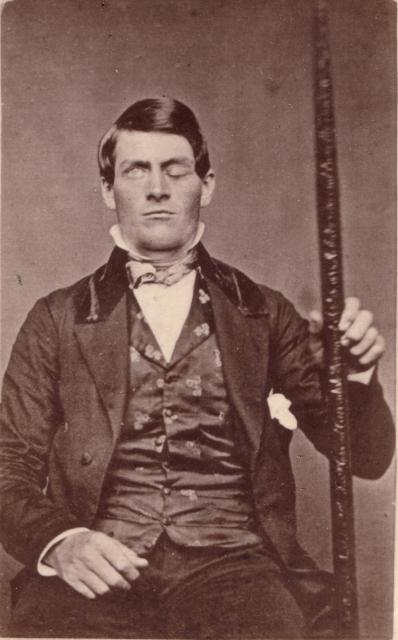
Phineas P. Gage
A Medical Marvel: The Phineas Gage Story Survival and Remarkable Recovery Personality Changes Later Life and Contributions Scientific Significance Legacy
A Medical Marvel: The Phineas Gage Story
Phineas Gage, born in 1823 in New Hampshire, was a robust young farmer with a knack for construction. By 1848, he had become an accomplished railway blastman, using a metal tamping rod to pack dirt and ignite explosives.
On September 13, 1848, tragedy struck. As Gage worked, his rod accidentally struck a rock, sparking an explosion. The six-pound, three-foot-long rod pierced his face, passing through his left cheek and exiting through the top of his skull.
Survival and Remarkable Recovery
Miraculously, Gage remained conscious after the accident and even joked about his predicament. Doctor Harlow, summoned to his aid, was astonished to find Gage seated outside a hotel. Despite the extensive damage to his frontal lobe, Gage's speech and memory remained intact.
Over the following months, Gage's physical health improved, though his appearance was altered by a disfigured left eye and a prominent forehead scar. However, his behavior had undergone a stark transformation.
Personality Changes
Gone was Gage's former energy and wit. He became impulsive, profane, and risk-taking. His once-steady work ethic crumbled as he failed to complete projects. Employers found his changed nature intolerable.
Later Life and Contributions
Gage returned home and became the subject of medical curiosity. He attended meetings at the Boston Medical Society and featured in the exhibitions of P.T. Barnum's museum. Despite his apparent physical recovery, his health declined, and epileptic seizures plagued him.
In 1852, Gage traveled to Chile, where he managed a team of horses on a stagecoach line. For a time, his behavior seemed to have stabilized. However, his symptoms returned, and he died in 1860 from a severe epileptic seizure.
Scientific Significance
After Gage's death, his skull and the tamping rod were recovered by Dr. Harlow and placed in the Harvard Medical Museum. In 2012, a groundbreaking computer simulation using Gage's skull and modern brain scans demonstrated the damage to his brain's frontal lobes. This confirmed the link between frontal lobe function and personality traits, contradicting previous beliefs.
Legacy
Phineas Gage's story has captivated medical professionals and the public alike. His case remains a testament to the incredible resilience of the human brain and the profound impact of brain injuries on personality. As modern science continues to unravel the complexities of the human mind, Gage's legacy as a medical marvel will continue to inspire awe and wonder.




