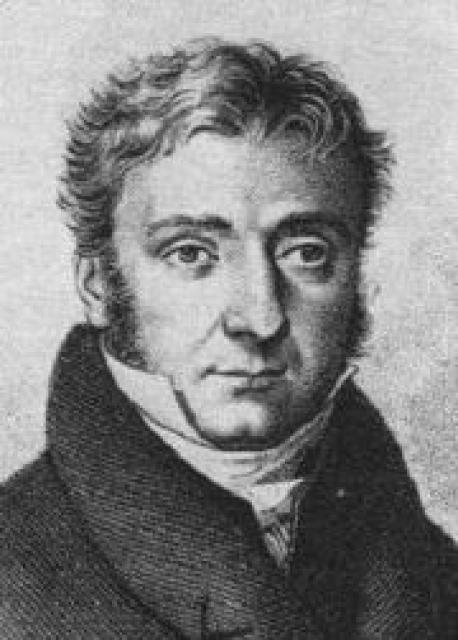
Pier Dulong
 France
Biography of Pierre Dulong
Pierre Louis Dulong (February 12, 1785, Rouen - July 19, 1838, Paris) was a French chemist and physicist. He studied medicine in Paris and then worked as a chemist in the laboratory of C.L. Berthollet at the Polytechnic School. In 1811, he became a professor of chemistry at the Veterinary School in Paris, and in 1820, he became a professor of physics at the Polytechnic School, eventually becoming its director in 1830. He became a member of the Paris Academy of Sciences in 1823 and its secretary in 1832.
Scientific Contributions
Dulong's main scientific research focused on general and inorganic chemistry. In 1811, he was the first to obtain nitrogen chloride, a highly explosive substance, which resulted in the loss of his eyesight and three fingers. In 1815, independently of H. Davy and almost simultaneously, he proposed the hydrogen theory of acids. He also isolated phosphoric acid for the first time, studied the composition and properties of oxalic acid and its salts, and investigated the thermal decomposition of oxalates. From 1824 to 1830, he collaborated with D.F. Arago to determine the pressure of saturated water vapor at various temperatures (up to 224 °C) and experimentally verify Boyle's law at pressures up to 27 atm. In 1830, he constructed a water calorimeter. Many of Dulong's studies were carried out in collaboration with A.T. Petit, the professor of physics at the Polytechnic School. In 1816, they invented the katathermometer, an instrument for measuring the vertical distance between two points that are not on the same vertical line. In 1818, Dulong and Petit derived the general formula for the cooling rate of solid bodies.
Major Scientific Achievement
Dulong's most significant scientific achievement was the law of heat capacity of solid bodies, established jointly with Petit in 1819. According to this law, the product of the specific heat capacities of simple solid bodies and the atomic mass of the constituent elements is a constant (approximately 25 J·g-1·K-1 in modern units). This regularity, now known as "Dulong-Petit's law," later served as the basis for the approximate estimation of atomic masses of heavy elements.


