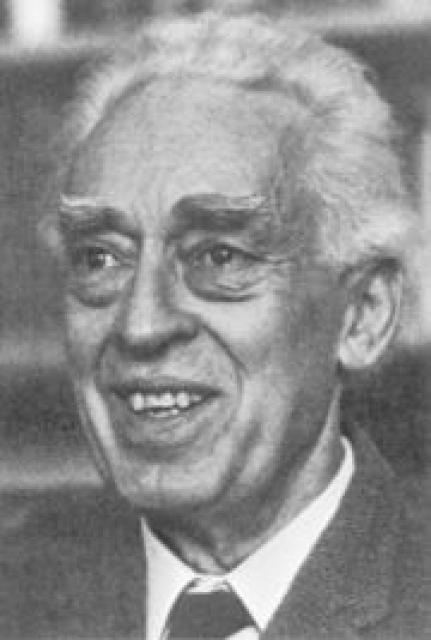
Piero Sraffa
 Italy
Italy- Piero Sraffa: A Biographical Sketch
- Academic Career and Political Affiliations
- Cambridge Years and Collaboration
- "Production of Commodities by Means of Commodities"
- Legacy and Influence
- Personal Life and Wealth
Piero Sraffa: A Biographical Sketch
Early Life and EducationPiero Sraffa was born in Turin, Italy, in 1898. His father was Angelo Sraffa, a professor of commercial law, and his mother was Irma. Sraffa graduated from the University of Turin in 1920, where he wrote a dissertation on inflation in Italy during and after World War I, supervised by Luigi Einaudi, a renowned Italian economist and future President of Italy.
Academic Career and Political Affiliations
In 1921-1922, Sraffa studied at the London School of Economics and Political Science. Upon his return to Italy, he served as Director of the Provincial Department of Labour in Milan, then as Professor of Political Economy at the universities of Perugia and Cagliari. During this time, he met Antonio Gramsci, a leading figure in the Italian Communist Party, and they became close friends, sharing similar ideological views. Sraffa's radical Marxist leanings drew the attention of John Maynard Keynes, who invited him to the University of Cambridge in 1927.
Cambridge Years and Collaboration
At Cambridge, Sraffa initially lectured and later became the Librarian of the Marshall Library of Economics, a position created by Keynes specifically for him. He formed an informal discussion group known as the "Coffee Club," which included Keynes, Frank Ramsey, and Ludwig Wittgenstein. Sraffa also began researching the life and work of David Ricardo, which led to his seminal work, "Production of Commodities by Means of Commodities."
"Production of Commodities by Means of Commodities"
Sraffa's "Production of Commodities by Means of Commodities" (1960) sought to refine the classical theory of value developed by Ricardo and others. He criticized neoclassical value theory and proposed alternative approaches, including his concept of aggregate capital as a dated quantity of labor. This sparked the "Cambridge Controversies" over capital theory.
Legacy and Influence
Sraffa's work has sparked heated debate over its implications for neoclassical economics. Some post-Keynesian economists have seen his critique as a refutation, while others have reconciled it with modern general equilibrium models. Nevertheless, Sraffa's scholarship, particularly his interpretation of Ricardo and his "Production of Commodities by Means of Commodities," is widely regarded as the starting point of neo-Ricardianism in the 1960s.
Personal Life and Wealth
Sraffa was known for his brilliance, humility, and devotion to scholarship. He amassed a vast library of over 8,000 volumes, part of which is now housed in the Trinity College Library. In his later years, he became financially well-off by investing in Japanese government bonds shortly after the atomic bombings of Hiroshima and Nagasaki. It is said that he held onto the investment for over a decade before finding a suitable alternative.


