Pierre Daniel Huet
 France
Biography of Pierre-Daniel Huet
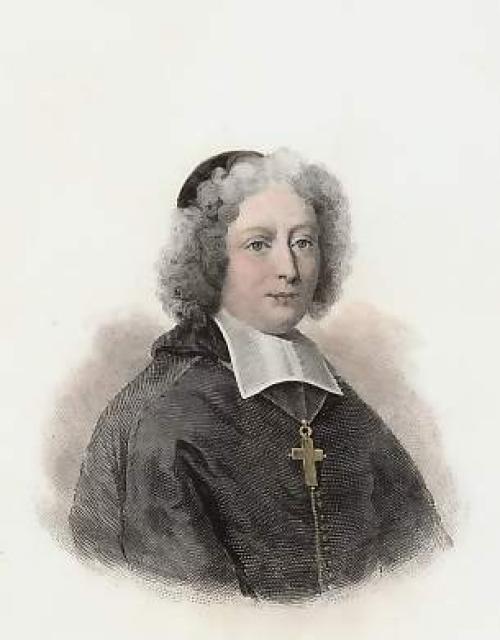
Pierre-Daniel Huet was a French scientist and religious figure, known for his contributions as an editor, founder, and leader in various academic and religious institutions. He was born in Caen and received his education at the Jesuit school in his hometown. By the age of 20, Huet had already established himself as one of the most prominent scholars of his time.
In 1651, Huet moved to Paris, where he met Gabriel Naudé, the librarian and director of the Mazarin Library. A year later, he traveled to Stockholm at the invitation of Queen Christina of Sweden, accompanied by Samuel Bochart. Huet also visited Amsterdam, Copenhagen, Leiden, and Stockholm, where he discovered fragments of Origen's "Commentary on St Matthew" in the royal library. This discovery inspired him to dedicate himself to the editing of Origen's works, leading to a serious disagreement with Bochart.
Huet played a significant role in founding the Academie du Physique in Caen, the first provincial academy of sciences under royal patronage. Initially, he acted as its de facto leader, with the assistance of Andre Graindorge, who focused on empirical research, particularly in anatomy. However, after Huet's departure, the academy quickly declined.
In 1662, Huet returned to the academy, but eventually moved to Paris in 1668. During his time in Paris, he became friends with Jean Chapelain and actively participated in the "Dispute of Ancients and Moderns," aligning himself with the "Ancients." Huet also engaged with Valentin Conrart and Paul Pellisson. He developed a keen interest in mathematics and astronomy, later shifting his focus to anatomy, particularly the human eye due to his nearsightedness. Huet performed over 800 dissections during his research. He later delved into chemistry and even wrote a poem about salt.
Despite his scientific pursuits, Huet remained active in society, regularly attending salons and art exhibitions. He also studied humanities, including Latin, Arabic, and Syriac languages.
In 1674, Huet was admitted to the French Academy. In 1676, he was ordained as a priest and appointed as an abbot. Seven years later, he became a bishop in Soissons, but eventually relocated to Avranches. Huet later settled in the Abbey of Fontenay, hoping for a quieter life. However, his expectations were shattered by constant legal disputes.
After retiring, Huet resided in Paris, where he passed away. His extensive library and numerous manuscripts were acquired by the king for the royal library.