Pierre-Louis Moreau de Maupertuis
 France
- Biography of Pierre-Louis de Maupertuis
- Contributions to Science
- Life in Prussia
- Scientific Works
- Relationship with Voltaire
- Legacy
Biography of Pierre-Louis de Maupertuis
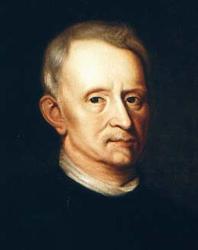
Pierre-Louis de Maupertuis, a French mathematician, astronomer, and geodesist, was born in Saint-Malo. Although he initially pursued a career as a dragoon officer, his natural inclination towards the exact sciences led him to retire in 1720 and live as a recluse.
Contributions to Science
After visiting England in 1728, Maupertuis became a devoted follower and disseminator of Isaac Newton's ideas, which were still relatively unknown in mainland Europe. In 1731, he was elected a member of the Paris Academy of Sciences and was subsequently appointed the head of a geodetic expedition to measure the meridian in Lapland.
Life in Prussia
In 1741, at the invitation of King Frederick II of Prussia, Maupertuis relocated to Prussia and participated in the Battle of Mollwitz. He was taken captive by the Austrians but was eventually released. From 1745 to 1753, he served as the president of the Physical-Mathematical Department of the Berlin Academy. In his later years, Maupertuis resided in Paris.
Scientific Works
Maupertuis authored several educational books on astronomy and published reports on the measurement of degrees, such as "La figure de la terre" (The Figure of the Earth) and "Relation du voyage au cercle polaire" (Report on the Journey to the Arctic Circle). In his treatise "Essay de Cosmologie" (1750), he presented several intriguing hypotheses and introduced the principle of least action to mechanics, which he had previously formulated in "Loix du mouvement et du repos" (Laws of Motion and Rest).
Relationship with Voltaire
Maupertuis is also known for his relationship with Voltaire. The latter wrote an epigram mocking Maupertuis' boundless ambition, portraying him as crushing the Earth with one hand. Maupertuis' attacks on Johann Samuel König, who challenged his invention of the principle of least action, prompted Voltaire to write "Docteur Akakia, médecin du pape" in addition to his famous work "Micromegas." Voltaire's attacks dealt a severe blow to Maupertuis' reputation and even hastened his death.
Legacy
Maupertuis passed away in the presence of two Capuchin monks. Before his death, he acknowledged that Christianity "leads man to the greatest good through the greatest possible means." In honor of his contributions, a crater on the Moon was named after Maupertuis. Two poetic messages from King Frederick the Great of Prussia were dedicated to Maupertuis, and they were translated into Russian by the young G. R. Derzhavin in his renowned work "Odes, composed at Mount Chitalagai." However, due to Derzhavin's lack of proficiency in French, Maupertuis was mistakenly referred to as "Mowterpia."