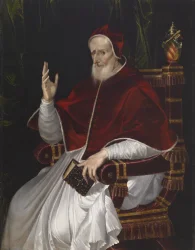
Pius V
 Papal States
- From Dominican friar to pope
- Reforming the Church
- Lepanto and the Holy League
- A reformer with a contested legacy
Pius V became pope at a moment when the Catholic Church was trying to answer the Reformation and put the Council of Trent’s reforms into practice. A former Dominican friar and inquisitor, he brought a strict, austere style to the papacy and pressed for clearer standards in worship and clerical life. His reign is also associated with the Holy League’s victory at Lepanto, while several of his policies—including the expulsion of Jewish communities from most of the Papal States—left a harsher legacy.
From Dominican friar to pope
Born Antonio Ghislieri in 1504 in Bosco, near Alessandria in northern Italy, he entered the Dominican Order as a young man and took the religious name Michele. He rose through the ranks of the Church as a teacher, prior, and inquisitor. In 1556 he became bishop of Nepi and Sutri, and in 1557 he was made a cardinal. His reputation for discipline and doctrinal rigor brought him into the leadership of the Roman Inquisition.
After the death of Pope Pius IV, the cardinals elected Ghislieri on January 7, 1566. He chose the name Pius V, honoring the predecessor who had promoted reform. He was crowned later that month and set about applying the decrees of the Council of Trent, which had concluded in 1563. Trent had clarified Catholic teaching and called for reforms in education, worship, and clerical conduct; it fell to the papacy and local church leaders to turn those decisions into practice.
Reforming the Church
Pius V sought to strengthen pastoral discipline, require bishops and priests to carry out their duties, and reduce what he regarded as abuses in the Church. He supported the publication of the Roman Catechism in 1566, intended to guide parish priests in teaching Catholic doctrine. In 1568 he promulgated a revised Roman Breviary for the daily prayers of clergy, followed in 1570 by a revised Roman Missal for the celebration of Mass. These reforms encouraged greater uniformity in worship across the Latin Church, while preserving certain older local rites.
His approach was uncompromising toward religious dissent. As pope, he continued to support the Inquisition and strengthened efforts to enforce Catholic orthodoxy. In 1570 he issued the bull Regnans in Excelsis, excommunicating Queen Elizabeth I of England and declaring that her subjects were released from obedience to her. The measure reflected the papacy’s rejection of Elizabeth’s religious settlement, but it also heightened political tensions and gave English authorities grounds to treat Catholic loyalty as a security threat.
Pius’s policies also targeted Jewish residents of the Papal States. In 1569 he ordered Jews to leave most of the territories under papal rule, with exceptions for Rome and Ancona. The decree forced communities from their homes and restricted where Jewish people could live. This coercive policy stands in sharp contrast to his efforts at internal reform and remains an important part of his record as ruler of the Papal States.
Lepanto and the Holy League
The Ottoman Empire’s expansion in the eastern Mediterranean alarmed Catholic rulers, but their political rivalries made cooperation difficult. Pius V worked to bring Spain, Venice, and the papal states together in the Holy League. On October 7, 1571, its fleet, commanded by Don John of Austria, defeated the Ottoman fleet at the Battle of Lepanto in the Gulf of Patras. The victory halted the immediate Ottoman naval advance in the western Mediterranean and became one of the defining events of Pius’s papacy, although it did not end Ottoman power or permanently settle control of the region.
Pius interpreted the victory in religious terms, crediting prayer and divine assistance. He promoted devotion to the Rosary and established a feast associated with the victory, strengthening Lepanto’s place in Catholic memory.
A reformer with a contested legacy
Pius V died in Rome on May 1, 1572. He was beatified in 1672 and canonized in 1712, and is honored as a saint in the Catholic Church. His papacy helped put Tridentine reforms into wider effect and encouraged a renewed institutional life within Catholicism.
His legacy is not simply one of reform. The same zeal that strengthened Catholic institutions also supported coercive measures against religious dissenters and Jews. Pius V’s reign therefore captures both sides of the Catholic Reformation: a drive to renew religious practice and an insistence on enforcing conformity through papal power.