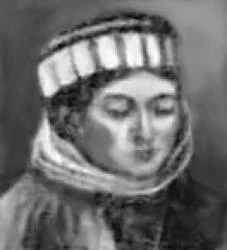
Pope Joan
Pope Joan is the name attached to one of the most enduring stories in European religious folklore: a woman who, according to medieval accounts, disguised herself as a man, rose through the church hierarchy, and briefly became pope. The tale has inspired chronicles, novels, paintings, plays, and arguments about women’s place in religious institutions. Yet it belongs to legend rather than established papal history. No contemporary record confirms that such a pope existed, and the story first appears in written sources centuries after the era in which later versions set it.
A Woman Behind a Disguise
The surviving accounts do not agree on Joan’s name, origin, or date. In the familiar later version, she is a highly educated woman from England who travels to Athens with a lover, adopts male clothing, and enters clerical life under a masculine identity. Her learning and ability help her advance through the church until she is elected pope. Some retellings call her “John Anglicus,” though that name is part of the legend, not evidence of a historical papal identity.
Medieval chroniclers also place her in different periods. The most popular chronology puts her between Pope Leo IV and Pope Benedict III in the ninth century. Earlier storytellers supplied other dates, including a setting in the eleventh century. This instability is one reason the tale is treated as folklore: its central character shifts as writers adapt the story to their own times and purposes.
The Story’s Medieval Origins
The first known written references emerged in the mid-thirteenth century. Dominican chronicler Jean de Mailly recorded a story of a woman who, living as a man, rose to become pope and gave birth during a public procession. Stephen of Bourbon also repeated a version of the tale. Later in the century, Martin of Opava’s widely circulated chronicle helped fix the legend in popular memory, giving it a fuller narrative and associating Joan with the sequence of ninth-century popes.
These writers were recording a tale already in circulation, not providing eyewitness testimony. Their versions differ in key details, and the gap of several centuries between the supposed events and the earliest surviving written accounts makes the story impossible to verify as biography. Modern historians do not include Joan in the historical succession of popes.
A Dramatic Discovery
The episode that made the story famous is its sudden exposure. In the later, widely repeated form, Joan becomes pregnant and goes into labor while leading or riding in a procession through Rome. The crowd discovers that the pope is a woman. What happens next varies: some accounts say she dies in childbirth, others describe her death at the hands of an angry crowd. Details such as the child’s identity, the exact route, and the burial place also change from one retelling to another.
Later versions connect the episode to Roman customs and landmarks, including a street said to have been avoided by papal processions. Such details gave the story a vivid local setting, but they do not establish that the event happened. They show how writers and storytellers continued to reshape the legend and attach it to features of the city.
Meaning and Afterlife
The tale’s appeal rests on several tensions: a woman’s intellectual ability, the limits placed on women in church leadership, the authority of the papacy, and the fear that an institution might be deceived from within. Depending on the teller, Joan could serve as a cautionary story about disguise and sexual transgression, a satire on clerical power, or an argument in disputes over the church. No single explanation for the legend’s origin has been demonstrated.
The story also took on new force during the Reformation, when Protestant writers sometimes used it to attack the authority and reliability of the papacy. Catholic scholars challenged the tale by examining the chronology and the lack of early evidence. Later generations treated Joan variously as a historical possibility, a symbol of suppressed women, or a literary figure. These interpretations reveal changing debates more clearly than they reveal a real pontificate.
Pope Joan remains culturally influential precisely because the story invites people to imagine a hidden woman occupying a role that tradition reserved for men. Her legend has appeared in histories, fiction, opera, theater, and visual art, often reflecting each era’s arguments about gender and institutional authority. The responsible distinction is clear: Joan is a memorable character in medieval legend, not a documented pope.