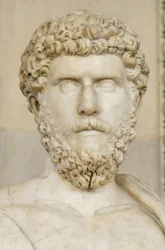
Ptolemy Ceraunus
Ptolemy Ceraunus was a Macedonian king whose brief reign ended in the upheaval caused by the Gallic invasions of the Balkans. A son of Ptolemy I of Egypt, he sought power beyond the kingdom he had been passed over to inherit. His audacious rise included the assassination of Seleucus I, one of the last surviving generals of Alexander the Great, but Ceraunus’s own rule lasted only about two years.
A Disputed Succession
Ptolemy was born to Ptolemy I and Eurydice, a daughter of Antipater, though the exact year of his birth is uncertain. He was once a leading candidate to succeed his father in Egypt. That prospect faded as his younger half-brother, the future Ptolemy II, gained the advantage in the royal succession. Ceraunus left Egypt and spent time among the rival courts of the Successor kingdoms.
After the defeat and death of Lysimachus at Corupedium in 281 BC, Ceraunus attached himself to Seleucus I, who had emerged as the victor. Seleucus crossed into Europe to claim Lysimachus’s former territories. At Lysimacheia, Ceraunus killed his host and seized the opportunity to claim power. The Macedonian army accepted him as king, and he took the throne in a landscape still unsettled by the wars that followed Alexander’s death.
King of Macedonia
Ceraunus ruled Macedonia from 281 to 279 BC. His nickname, meaning “Thunderbolt,” suited the speed and force of his ascent, though the same boldness could become recklessness. The kingdom faced competing claims, military threats, and uncertainty over its borders. His position also depended on shifting alliances with neighboring rulers, including Pyrrhus of Epirus and Antigonus Gonatas.
He married his half-sister Arsinoe II, the widow of Lysimachus, in a political alliance aimed at securing control of Cassandreia and her family’s influence. Ancient accounts say Ceraunus promised to protect Arsinoe’s sons, then arranged for them to be killed after gaining access to the city. Arsinoe escaped into exile. The episode, preserved in hostile and often moralizing narratives, became one of the most notorious stories attached to his rule.
The Gallic Invasion and Death
In 279 BC, Gallic forces advanced into Macedonia as part of a wider movement south into Greece. According to the surviving account of Justin, the invaders sent envoys to gauge Ceraunus’s willingness to negotiate. The king rejected the approach and refused an offer of military aid from the Dardanians, confident that Macedonian arms could meet the threat.
Ceraunus marched against the invaders before he had assembled the full strength of his forces. His army was defeated, and he was killed during the campaign. Later accounts describe him being captured and beheaded, with his head displayed by the victors; the details vary across the ancient tradition. His death left Macedonia vulnerable, and succession passed rapidly among rival claimants before Antigonus Gonatas established a more durable dynasty.
Legacy
Ptolemy Ceraunus’s reign was too short to build lasting institutions or a stable succession. He is remembered instead for a dramatic sequence of political reversals: a displaced Egyptian prince, a kingmaker’s assassin, and a ruler overwhelmed by invasion. His life illustrates how precarious kingship remained in the generations after Alexander, when military success could open a path to a throne but rarely guarantee that it would be held.