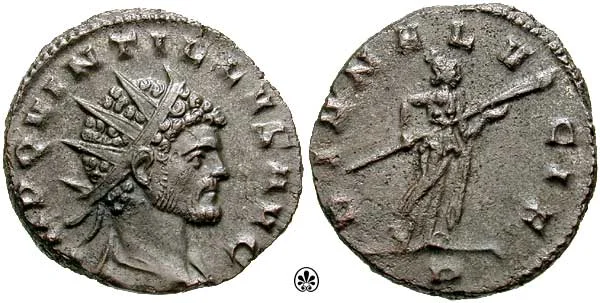
Quintillus
Quintillus was Roman emperor for a brief and poorly documented period in 270, during the third-century crisis that repeatedly brought soldiers and rival claimants into the struggle for power. The brother of Emperor Claudius II Gothicus, he was proclaimed after Claudius’s death and initially received the support of the Senate. His rule was soon challenged by the successful general Aurelian, and ancient sources disagree about how long Quintillus remained emperor and how he died.
A brother succeeds to the throne
Quintillus, whose full name is usually given as Marcus Aurelius Claudius Quintillus, was the brother of Claudius II Gothicus. The surviving accounts reveal little about his early life or political career before 270. Claudius had won renown for his victory over the Goths at Naissus, but died during an epidemic, generally identified as plague, while campaigning in the Balkans.
After Claudius’s death, Quintillus was proclaimed emperor. The precise location of his elevation is uncertain, but ancient accounts say that he was recognized by the Senate in Rome. That recognition mattered: emperors of the period needed the backing of the army, but senatorial support could lend legitimacy to a ruler in the capital. Some later writers describe Quintillus as a moderate and capable man, though the brevity of his reign leaves little independent evidence to assess his rule.
A contested reign
Quintillus’s authority was quickly undermined by the rise of Aurelian, a senior military commander with troops stationed along the Danube. The army hailed Aurelian as emperor while he was dealing with threats on the frontier. The resulting contest illustrates how unstable imperial succession had become: a candidate recognized at Rome could be challenged by a general commanding the forces the empire needed most.
The duration of Quintillus’s reign is disputed. Eutropius and some other writers give only seventeen days, while the Chronographer of 354 records seventy-seven days, and Zosimus describes a reign of a few months. These differences may reflect uncertainty about when his rule began or the point at which Aurelian’s rival claim became decisive.
The accounts of Quintillus’s death also vary. Some say he was killed at Aquileia, while others report that he died by suicide after his troops deserted him. The ancient historian Dexippus, as quoted in a later source, reportedly said only that Quintillus had died, without specifying the cause. The limited evidence does not allow a definitive conclusion.
A footnote to Aurelian’s rise
Quintillus’s reign left few records of policy or major events. Its historical significance lies chiefly in the transition between Claudius II and Aurelian, whose subsequent rule would reunify much of the Roman Empire after years of fragmentation. The Senate’s recognition of Quintillus suggests that he possessed a measure of political legitimacy, but it could not guarantee that his brief rule would withstand a rival supported by the army.
Because the sources are sparse and contradictory, Quintillus remains one of the more obscure emperors of the third century. His short appearance on the imperial stage captures the instability of the age: succession could be announced in Rome, contested by distant legions, and decided within weeks on the battlefield or through the collapse of military support.