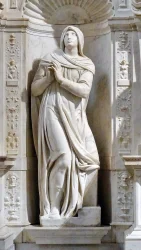
Rachel
Rachel is one of the matriarchs of the Hebrew Bible, remembered as Jacob’s beloved wife and the mother of Joseph and Benjamin. Her story in Genesis follows love and rivalry within a family, years of longing for children, and a death that later became a lasting image of maternal grief.
A love story at the well
In the biblical account, Rachel was the younger daughter of Laban and a shepherdess. Jacob met her at a well after arriving in the region to seek relatives. He fell in love with her and agreed to work for Laban for seven years to marry her. Laban deceived him at the wedding, giving him his elder daughter Leah instead. Jacob then married Rachel as well, after agreeing to serve Laban for another seven years.
Rachel initially could not conceive, while Leah bore several children. The sisters’ rivalry shaped their household, and Rachel eventually gave Jacob her servant Bilhah as a concubine, whose sons were counted among the family’s children. In time, Genesis says, Rachel gave birth to Joseph. She later bore a second son, Benjamin.
The family’s journey
When Jacob left Laban’s household to return to Canaan, Rachel took her father’s household idols without telling him. The story depicts her as resourceful and protective, but also caught in the tension between her husband and the family she was leaving behind.
Rachel died while giving birth to Benjamin, as Jacob’s family traveled toward Ephrath, identified in Genesis with Bethlehem. Jacob buried her beside the road and set up a marker at the grave. The location remembered as Rachel’s Tomb became an important place of pilgrimage and devotion, though biblical texts also preserve differing traditions about its precise setting.
A mother remembered
Rachel’s significance reaches beyond the family narrative. In the Book of Jeremiah, she is imagined weeping for her descendants as they are carried into exile, a lament that is answered with a promise of return. The Gospel of Matthew later echoes this passage in its account of grief over children in Bethlehem.
Jewish tradition remembers Rachel as a compassionate mother who continues to plead for her people. Her biblical story—marked by longing, conflict, and loss—has made her an enduring symbol of both maternal suffering and hope.